Published on Show Me Mizzou April 24, 2026
Story by Chris Blose, MA ’04
Illustrations by Daria Kirpach
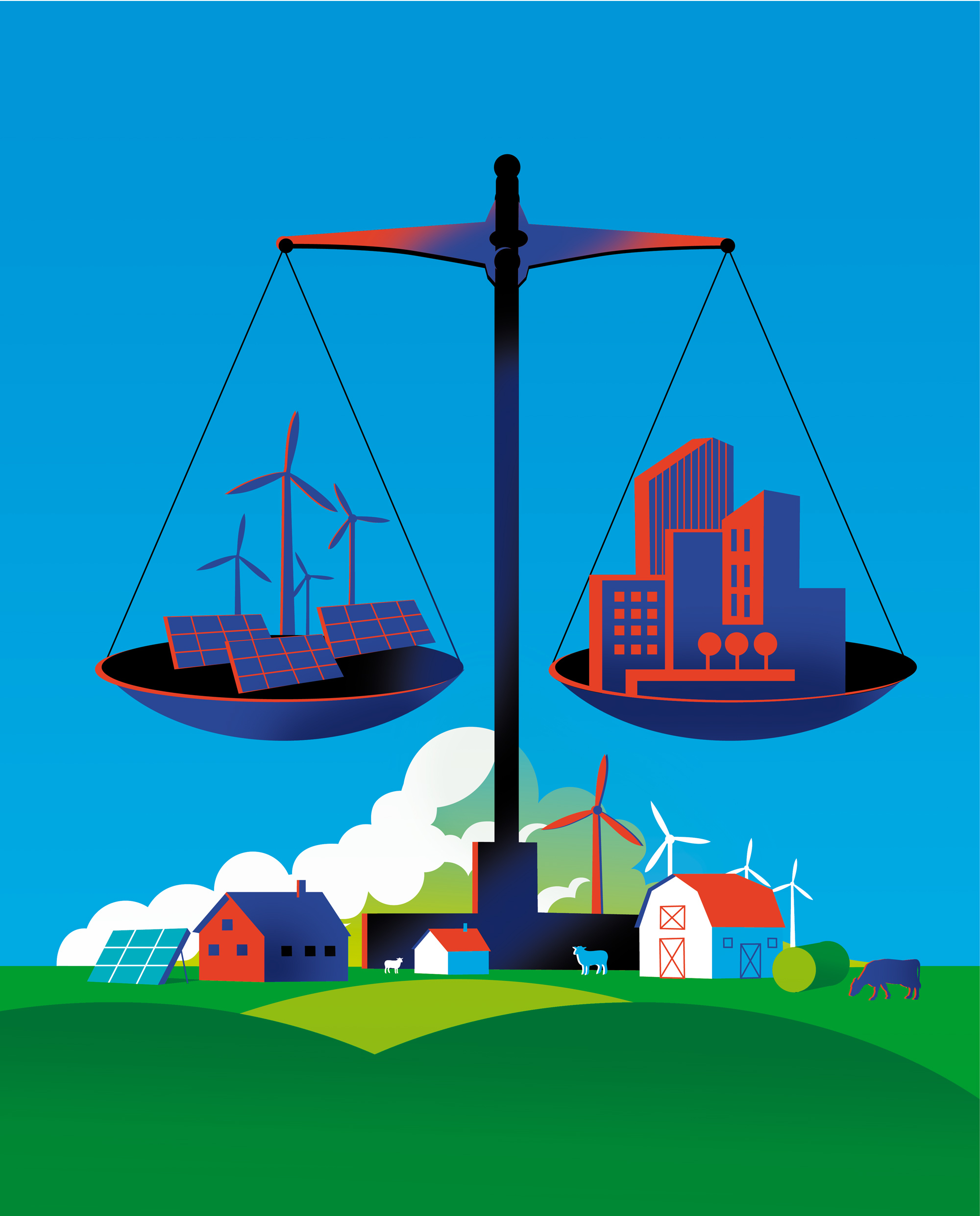
Agricultural communities have future opportunities in the energy sector not available to their urban counterparts.
“Rural communities generally bear the brunt of infrastructure, even if the energy serves larger population centers,” says Mike Sykuta, associate professor in Mizzou’s College of Agriculture, Food and Natural Resources (CAFNR) and director of Mizzou’s new Center for Rural Energy Security (CRES).
Infrastructure such as pipelines for oil and natural gas and powerlines for energy transmission dot our rural landscapes. Increasingly those landscapes also include wind turbines, solar installations and energy-hungry server farms. At the same time, a sparser rural population leads to a higher cost of energy transmission per person, a challenge compounded by lower-than-average incomes.
Each of these issues has implications for rural land and the people who live on it.
“They’re in the crosshairs of a lot of large-scale national transmission development,” Sykuta says, “but at the same time, the benefits of some of the newer technologies could have disproportionate benefits for rural communities versus urban communities.”
CRES exists to analyze and understand these trends, challenges and opportunities, whether they relate to infrastructure, cost or security. As Sykuta notes, there’s no shortage of energy-related think tanks in the United States. However, until now, few if any have focused on the perspective of people far from the nation’s coasts.
“It was clear to us that rural areas are often overlooked, even though they’re often where critical energy infrastructure is sited,” says Adrienne Ohler, an economist, associate professor in CAFNR and CRES affiliate who collaborates on research with Sykuta.
CRES launched in 2025 to make sure rural areas are not overlooked in the future of energy policy. Sykuta, an economist with applied research experience as the executive director of Mizzou’s Financial Research Institute, knows a land-grant university in an agricultural state in the middle of the country is perfectly suited to deliver such research and perspective. When University of Missouri President Mun Choi announced the construction of the Energy Innovation Center and signaled the desire for Mizzou to be at the center of energy advances and conversations, Sykuta knew the time was right for CRES.
“Our mission is to provide a nonpartisan, unbiased perspective on how federal and state energy policies affect rural America,” he says. Put simply, he wants CRES to be an “honest broker” of information for policymakers, the public and industry.
Applying Research to Rural Realities
When a large-scale renewable energy project comes to a rural county, what happens to existing industries? Does the county see more money? Do the people who live there get bigger paychecks?
One of CRES’s first major research projects, “Economic Effects of Large-Scale Wind and Solar Projects,” sets out to answer these questions through detailed economic analysis. Sykuta, Ohler and fellow CRES affiliate Austin Landini started by gathering data on every single solar and wind installation in each U.S. county from the years 2001 to 2021.
The researchers broke out specific counties using the USDA’s definition of “rural,” in particular counties with more than 10 percent of the economy devoted to agriculture. Now they are examining how wind and solar installations affect a county’s gross domestic product, employment and wages. Those three initial factors are established in an initial working paper, likely to be published this year. Now, the team is diving deeper into how the installations affect rural sectors such as agriculture, manufacturing and construction.
“So far, wind seems to have large, significant positive effects,” Sykuta says, referring to increases to a county’s GDP, employment levels and wages. When getting into specific industries, there are “somewhat significant” effects on the utility and construction sectors from wind. There seems to be no significant effect, positive or negative, on agriculture or manufacturing.
The story for solar projects is more neutral. According to the study, they have no significant effect, positive or negative, on county GDP, employment or wages. They also seem to have no effect on the agriculture, utility or construction sectors, although there’s weak evidence of minor negative effects on manufacturing after five years.
Neutral effects may seem anticlimactic, but they’re actually quite telling, Ohler says. “If we are replacing large amounts of land, you might expect that that would have an impact on agriculture, but we don’t,” she says. “I think the real story is there’s either not much of an effect, or at least there’s no negative effect.”

Research results such as this are both practical and useful for a number of stakeholders. First, they provide policymakers clear economic data to use as they craft legislation around future renewable energy projects. Second, companies in energy and other affected industries can use them in planning and strategy. CRES gets funding from industry partners such as the Missouri Farm Bureau, the Missouri Public Utility Alliance, Ameren and various energy cooperatives because those companies benefit from unbiased research produced and vetted by an honest broker.
Perhaps most important, Ohler says, communities and their leaders can use the information to make informed decisions about their own future, including what kind of energy projects they choose to adopt.
What Comes Next
Even with such high-impact research, Sykuta points out CRES is still in a nascent stage.
The team is intentionally multidisciplinary, with CRES affiliates coming from CAFNR; the College of Arts and Science, including both the Department of Economics and the Truman School of Government & Public Affairs; and the College of Engineering. Sykuta hopes to increase such collaboration, both at Mizzou and beyond, in the future. He also hopes to hire team members in strategic communications to ensure CRES’ work reaches the people who need it.
The importance of that last task can’t be overstated. “Some of what we hope to be able to do, as a land-grant university should do, is to translate scientific research that’s primarily delivered to academic audiences and pull out the lessons that it has for policy,” Sykuta says.
Case in point: Zack Miller’s long-term climate modeling research. Miller, a CRES affiliate and chair of the Department of Economics, says that he typically does not publish in a policy- or public-facing realm. But his work absolutely has practical value.
For example, Miller uses statistical modeling to examine the cycles of climate change, including when it slows down and when it accelerates. “I find this 80-year fluctuation, and it has policy implications,” Miller says. “A policymaker can’t look at short-term results and assume they’re the result of any one policy.” They need to look at a number of factors instead, including long-term patterns.
Still, as Miller notes, his work is intended for an audience steeped in economic methodologies and statistics. “There’s a different need when you take that to a policymaker,” he says. CRES hopes to extract the key points from such rigorous research and present it in a way that makes clear sense to the public and the legislators who serve them.
Two other CRES projects already underway have clear connections to rural needs. One examines the increased electrification of heat and air conditioning in rural households, and how they affect the risk of payment delinquencies for customers as bills rise in the summer and winter. Another tracks current county ordinances across Missouri for the zoning of wind and solar projects; the goal is to create an annual survey to see how the regulatory landscape changes over time.
Other topics are ripe for CRES research. Ohler points to a divisive but pervasive topic: the infrastructure and energy usage of large-scale data centers, which she sees as a massive opportunity for policy-driven research as demand increases in the AI era. So, too, is the study of security and regulation as it relates to mission-critical military infrastructure. Many military installations, including some in Missouri, are tied to local and rural energy grids. All such research, and the insights that come from it, will be filtered through the lens of what matters most to rural communities in the state of Missouri and across the country.
“This is not just where Missouri has a comparative advantage,” Miller says. “It’s also where Mizzou has a comparative advantage.”
To read more articles like this, become a Mizzou Alumni Association member and receive MIZZOU magazine in your mailbox. Click here to join.