Oct. 13, 2026
Contact: Sara Diedrich, diedrichs@missouri.edu
Photo by Ben Stewart
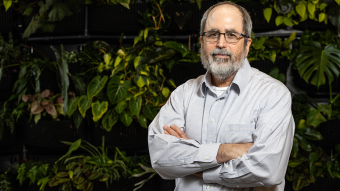
The University of Missouri knew what it had in Zachary Berndsen.
A talented biochemist and structural biologist, Berndsen came to Mizzou with expertise in cryo-electron microscopy — using a powerful microscope to see what tiny biological molecules look like in three dimensions — and a drive to use it to solve a problem that had stumped scientists for decades.
But he needed another kind of expertise: someone who could use computers to build detailed structural models to help make sense of what he saw.
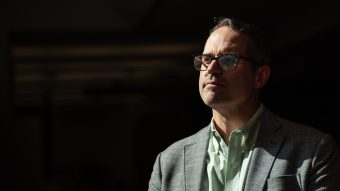
Mizzou recognized the opportunity. It brought physicist-turned-biophysicist Keith Cassidy to campus, adding expertise in molecular simulations that complemented Berndsen’s ability to see the protein itself.
The result was a scientific breakthrough. For the first time, researchers could see the structure of ApoB100, the protein component of LDL — commonly known as “bad cholesterol” — which plays a major role in cardiovascular disease, the world’s leading cause of death. This discovery could help researchers develop more targeted ways to prevent and treat heart disease and their work was published in the journal, Nature.
For Berndsen, an assistant professor in the School of Medicine, figuring out the protein’s structure was an irresistible challenge.
“Here’s this protein that is incredibly important, and nobody in the world knows what it looks like,” he remembers thinking. “It seems like one of the biggest unsolved problems in structural biology, and the technology is now available to finally solve it with the right experimental design and combination of expertise.”
For Cassidy, an assistant professor in the College of Arts and Science, the work represented something different: the coming together of tools and interests he had spent years developing. His background in physics, computational structural biology and molecular simulation gave him a way to approach the problem from another direction.
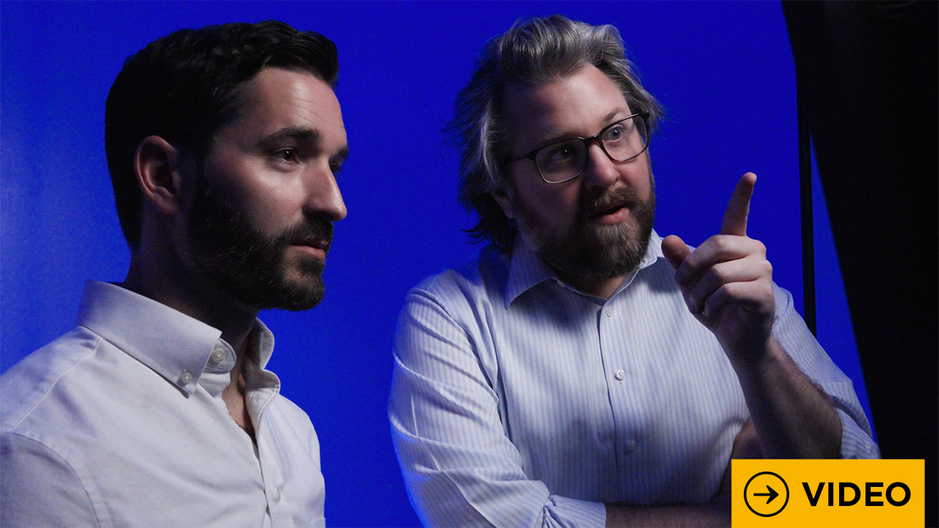
“It really became a meeting of the minds,” Cassidy said.
With access to the Electron Microscopy Core at the Roy Blunt NextGen Precision Health building and Mizzou’s supercomputing cluster, Hellbender, the researchers were finally able to reveal the specific shape and structure of ApoB100. Berndsen used a powerful microscope to capture detailed images of the protein, while Cassidy used those images along with artificial intelligence and simulations to piece together an even clearer picture of its shape.
But for Berndsen and Cassidy, the discovery didn’t answer every question. It raised new ones — and some that hit close to home.
A family history of heart disease
Long before either of them discovered the structure of ApoB100 and saw a 3D image of it on a computer screen, they had experienced the effects of cardiovascular disease in their own families.
Berndsen grew up in St. Louis with a family history of heart disease on his father’s side. He saw first-hand the impact of heart disease on his family at a young age, but he hoped to overcome this through healthy lifestyle choices. He was active, athletic, and always paid close attention to nutrition.
However, while following a very low-carbohydrate diet, Berndsen saw his cholesterol rise dramatically. The experience deepened his interest in lipoproteins and the complex role they play in human health and disease.
For Cassidy, who grew up in rural Arkansas, heart disease was woven into his family history. His father began having stents placed in his early 50s. Two great-grandfathers and one uncle died of heart attacks, while several other uncles, aunts and his grandmother either survived heart attacks or underwent major open-heart surgery.
For years, though, that history was simply part of life. It wasn’t a scientific problem Cassidy expected to solve.
Then he and Berndsen made their discovery at Mizzou.
“Having that scientific foothold has made me realize that I might actually be able to contribute to solving the conditions that have affected my family for generations,” Cassidy said.
What comes next
Uncovering the structure of ApoB100 was never meant to be the end of the story for Berndsen and Cassidy.
Their discovery opened a much bigger set of questions about lipoproteins.
“These molecules are connected not only to cardiovascular disease, but to conditions including Alzheimer’s disease, diabetes and other metabolic disorders,” Cassidy said.
Cassidy hopes to apply their approach to other lipoproteins.
“By extending out work on AppB100, we may be able to uncover common principles that explain how these molecules behave in the body and what goes wrong in disease,” he said.
Berndsen is building on their discovery to guide his future research through a newly awarded grant from the NIH and hopes to one day become the world’s expert on this one protein. Mizzou is giving him the chance and the infrastructure he needs to keep pursuing that goal.
“This work has opened doors to so many other questions,” he said. “There is still a tremendous amount to discover in this area, and we are now uniquely positioned to make those discoveries”