May 11, 2026
Contact: Eric Stann, StannE@missouri.edu
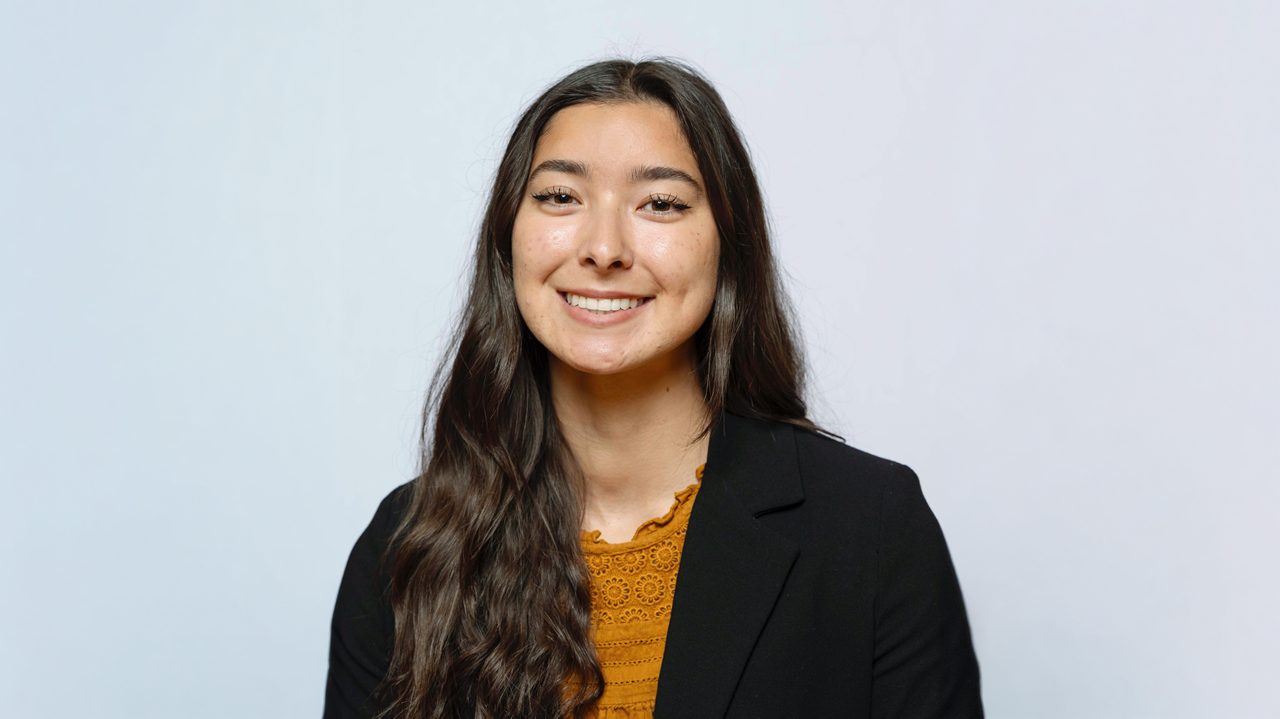
Photo courtesy of Rachel Riley
Every map begins with a point of origin, the anchor that gives it meaning. For senior Rachel Riley, that place is Kansas City, Missouri, where she grew up and plans to return.
After graduating with a degree in geography and emphasis in geographic information systems (GIS) this weekend, Riley will begin her career as an assistant GIS specialist in environmental services at Burns & McDonnell, where she will manage data and design dashboards that support projects across the region.
For her, going home isn’t about retracing previous steps. It’s about seeing familiar places through new eyes.
“I get to use what I’ve learned in a city that already matters to me,” she said. “Mizzou helped me see my community differently, and now I get to put that perspective to work.”
Starting coordinates
A high school human geography course helped Riley understand how place influences opportunity and connection. Her interest deepened through Science Olympiad, a national nonprofit focused on STEM education that allowed her to compete in areas such as remote sensing. By analyzing satellite imagery and location-based data, she discovered how maps can reveal patterns and turn raw information into insight.
Together, those early experiences pointed her toward the geography and GIS programs in Mizzou’s College of Arts and Science.
“I like that geography is connected to everything,” she said. “It’s not just about memorizing maps. It’s about understanding how people, systems and places shape experiences.”
Her academic path, which includes minors in public health and French, reflects her growing interest in tackling real‑world challenges at the crossroads of information and community.
Developing her waypoints
At Mizzou, Riley’s curiosity quickly moved from theory to practice. She joined a health geography lab, where she began using GIS to explore public health issues affecting Missouri communities. For one project, she looked at school district maps to examine relationships between special education plans for students with autism and whether different geographic areas share similar demographics.
In another class, she analyzed chronic kidney disease cases in Kansas City, translating rows of medical data into clear visuals.
“When you put health data on a map, geographic patterns stand out right away,” she said. “It helps explain why some communities face more barriers than others.”
Along the way, Riley presented her research at the Missouri GIS Conference, the Applied Geography Conference and the MidAmerica GIS Consortium Symposium, gaining valuable experience explaining complex spatial analysis to professional audiences.
By learning how to clean data, automate mapping processes and work with large datasets, she strengthened the technical skills that later translated into an internship with Garmin, where she applied GIS tools to commercial mapping products.
“Each of these experiences showed me how my knowledge functions outside the classroom, and how maps can play a role in everyday decision-making,” she said.
Finding her bearings
As Riley grew more confident in her technical abilities, building community became just as central to her Mizzou experience.
Outside the classroom, she was involved in Chi Alpha, a campus ministry where she helped lead a small group and support fellow students. Within the geography department, Riley served as vice president of the geography club and later as president of Gamma Theta Upsilon, the international geography honor society.
In those roles, Riley focused on creating spaces where students felt comfortable showing up, even if they were attending for the first time.
“I wanted people to feel welcome,” Riley said. “That sense of belonging really matters to me.”
Now, as Riley prepares to return to Kansas City, her route continues to take shape, guided by where she started, what she’s learned and how she plans to use geography to better understand and serve the place she calls home.