Published on Show Me Mizzou Aug. 28, 2026
Story by Mark Godich, BJ ’79
Photos by Mizzou Athletics
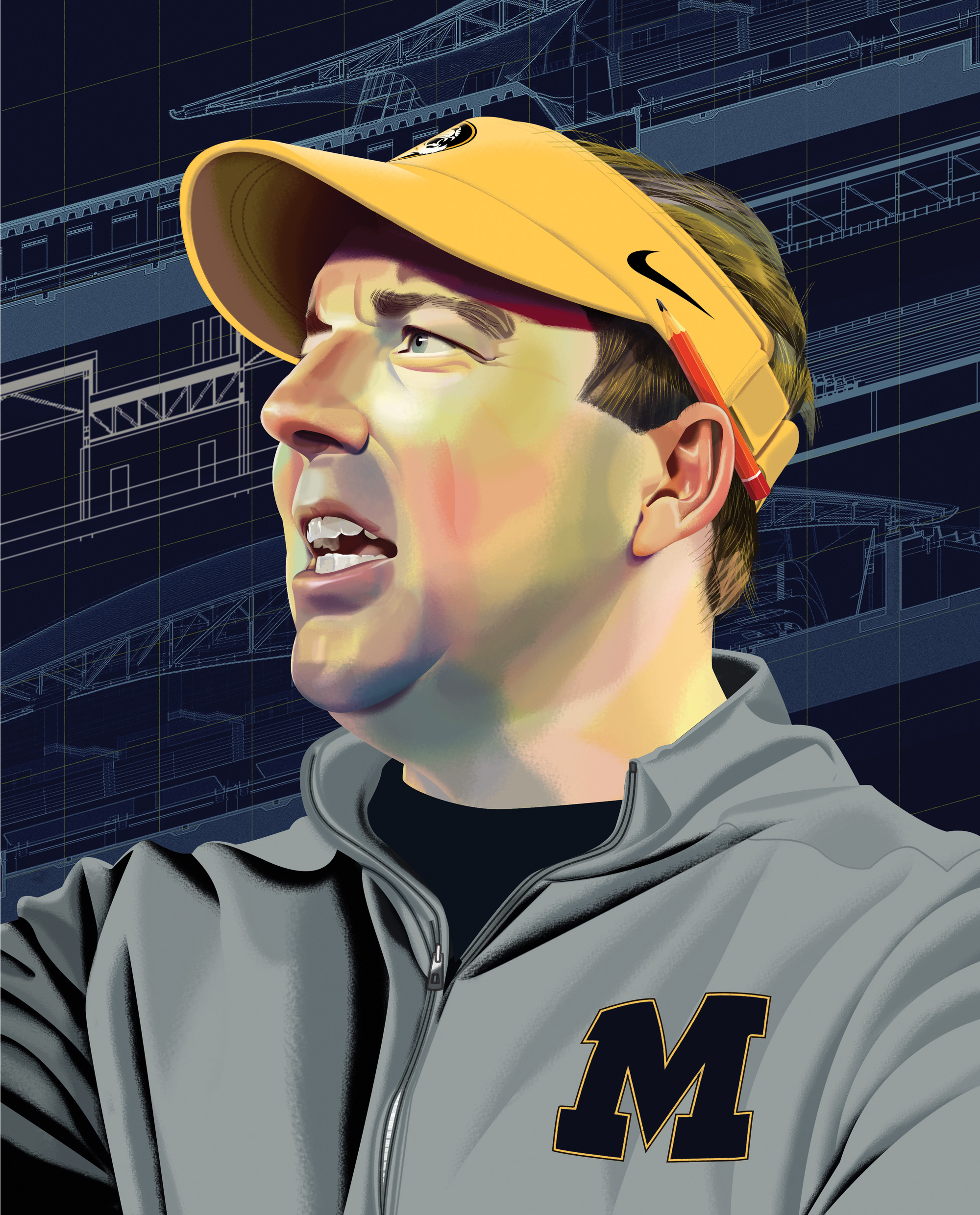
Every day he walks into his office high atop the south end zone of Memorial Stadium, Eli Drinkwitz can see the progress. Two years ago, the view from his window showed nothing more than a mass of rubble and bulldozers shoving dirt this way and that. Now, on a sparkling spring morning, as he reflects on his time as the football coach at the University of Missouri, work crews scramble to put the finishing touches on the sprawling $250 million expansion at the opposite end of Faurot Field.
“Drink,” as he’s known around the state and pretty much everywhere else in the college football universe, has a catchphrase he likes to share with his players and staff. It is appropriate not only for the massive project that is nearing completion but also for the ongoing construction Drinkwitz has feverishly undertaken with his football program. Eight simple words:
Little by little. A little becomes a lot.
Make no mistake: Memorial Stadium will always be “the house that Gary Pinkel built.” The former Mizzou coach was, you might recall, fond of saying that if you don’t see cranes in the sky, something’s wrong. But even as Pinkel laid the foundation by taking the Tigers to summits they hadn’t ascended in almost five decades and paving the way for Mizzou’s entry into the premier conference in college athletics, Drinkwitz is the man behind the expansion phase.
He was a 36-year-old wunderkind when he arrived on campus in late 2019 after a year as the head coach at Appalachian State. Now, hard as it might be to believe, Drinkwitz begins his seventh season in Columbia as the second-longest tenured head coach at the same school in the SEC, behind only Georgia’s Kirby Smart. He ranks fourth in career wins at Mizzou, with 47, ahead of Warren Powers (46 wins) and trailing Dan Devine (93 wins). He and Pinkel are the only coaches to guide the Tigers to consecutive 10-win seasons. Last season, Drinkwitz and the Tigers were a play here and there from completing the hat trick. He has accomplished all this while continuing to evolve on the fly in a sport whose landscape seems to experience seismic shifts by the day.
He estimates his staff has grown by 50 percent over those seven years. He has added a player personnel department and a small army of quality-control assistants. He has dealt with staff turnover as seamlessly as possible. He is successfully navigating the ever-expanding transfer portal and an ever-expensive NIL. High school recruiting is nothing like it once was because the courting of those freshmen doesn’t stop when they set foot on campus. Yet amid the chaos, he seems unfazed by it all.
“If you aren’t living it every day, it’s really, really crazy,” Drinkwitz says matter-of-factly. “But for us, it’s become the new normal. You have to adjust and adapt if you want to survive.”
Cornerstones
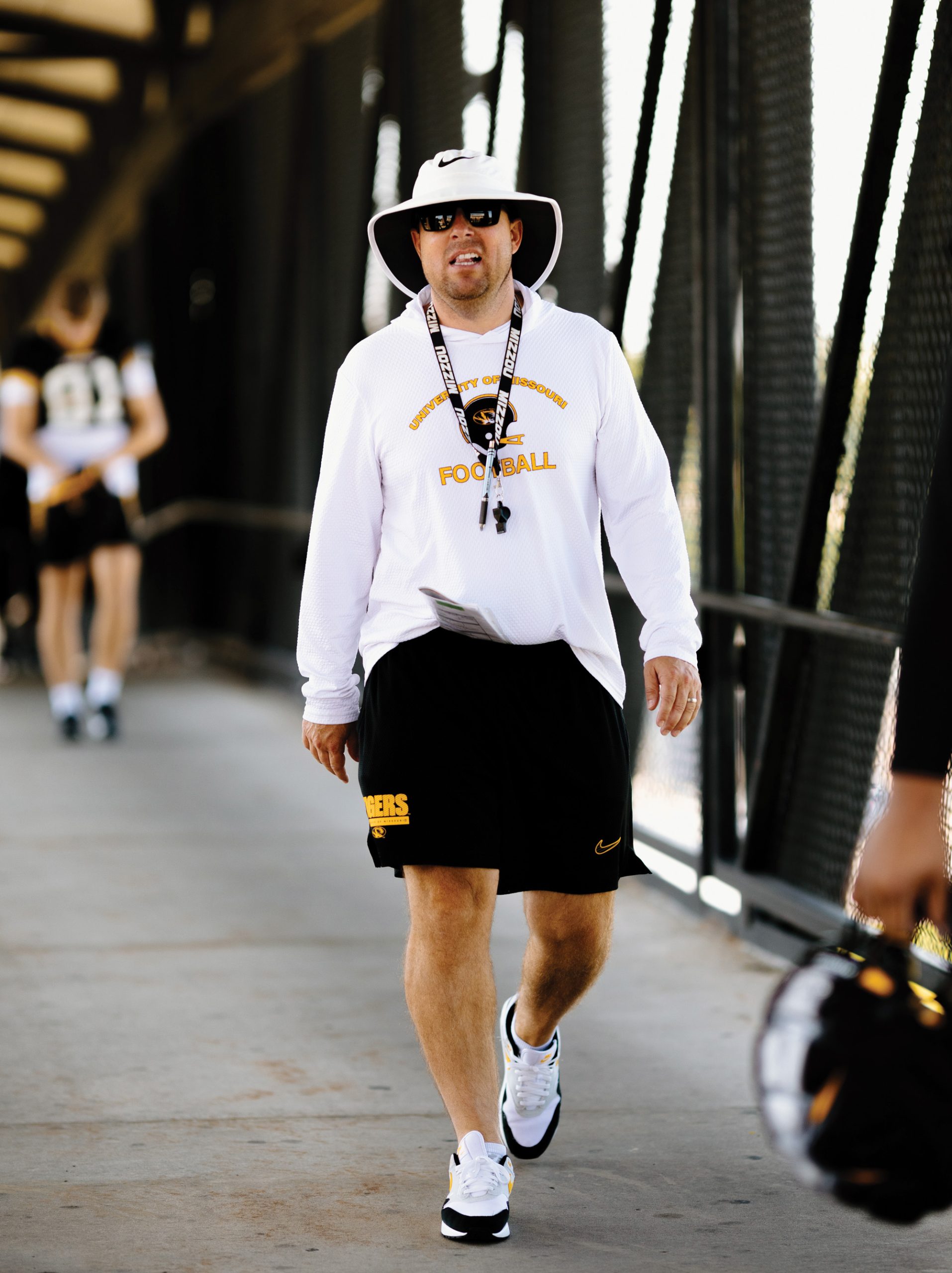
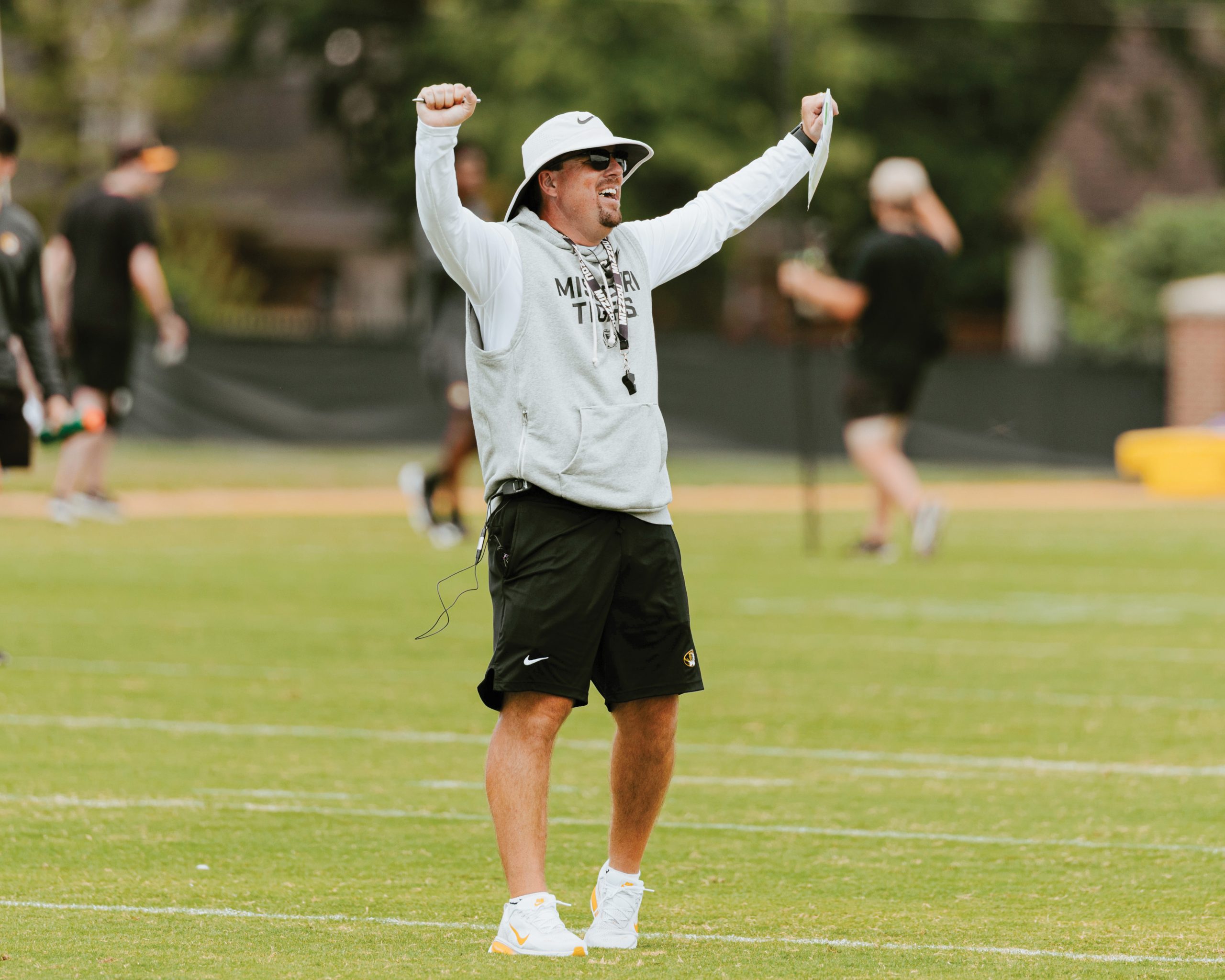
Early on, Drinkwitz wore multiple hats: head coach, offensive coordinator, quarterbacks coach, play-caller. Now he has adapted and brought on a new offensive coordinator, Chip Lindsey, and QB coach, Garrett Riley. Lindsey will call the plays with an assist from Riley, an assistant under Drinkwitz at App State who also has experience as a coordinator and play caller. New tight ends coach Alex Atkins also has coordinator experience at the Power Four conference level.
It is quite the brain trust, and although some offense-minded head coaches might be reluctant to relinquish their stranglehold on the system, Drinkwitz wouldn’t have it any other way. (Not to worry, Mizzou faithful. The highly effective outside zone run that has become a Drink staple isn’t being retired.) From his days growing up in Alma, Ark., he always has had a curiosity about him and been eager to improve and grow while soaking up as much knowledge as possible. One colleague in the athletic department marvels at Drinkwitz’ bandwidth and his ability to engage in conversation with anyone on any subject.
“I think that’s a tribute to the way my parents raised me,” Drinkwitz says, “and having a background of being around a lot of different people and in a lot of different places in life. You have to have confidence in who you are and humility in who you are. I think it’s being able to meet people where they are and not having a sense of entitlement. But also having a sense of humility of trying to learn from every person you come in contact with.”
An All-American tackle at Mizzou and a 1981 first-round draft pick of the Dallas Cowboys, Howard Richards knows a thing or two about the game. He played for the legendary Tom Landry. As an analyst who is beginning his 16th season in the Mizzou Network radio booth, Richards has had a front-row seat to witness Drinkwitz’s maturation.
“To me, the best part about Drink is he’s evolved as a head coach,” Richards says. “Every year, I think he gets better and better. You can see it in his demeanor. I love that he is learning as the CEO of this program how to do his job better. The toughest part, whether you are the head coach or the head of a corporation, if you want to thrive, you’ve got to identify the weaknesses and make hard decisions and hard changes.”
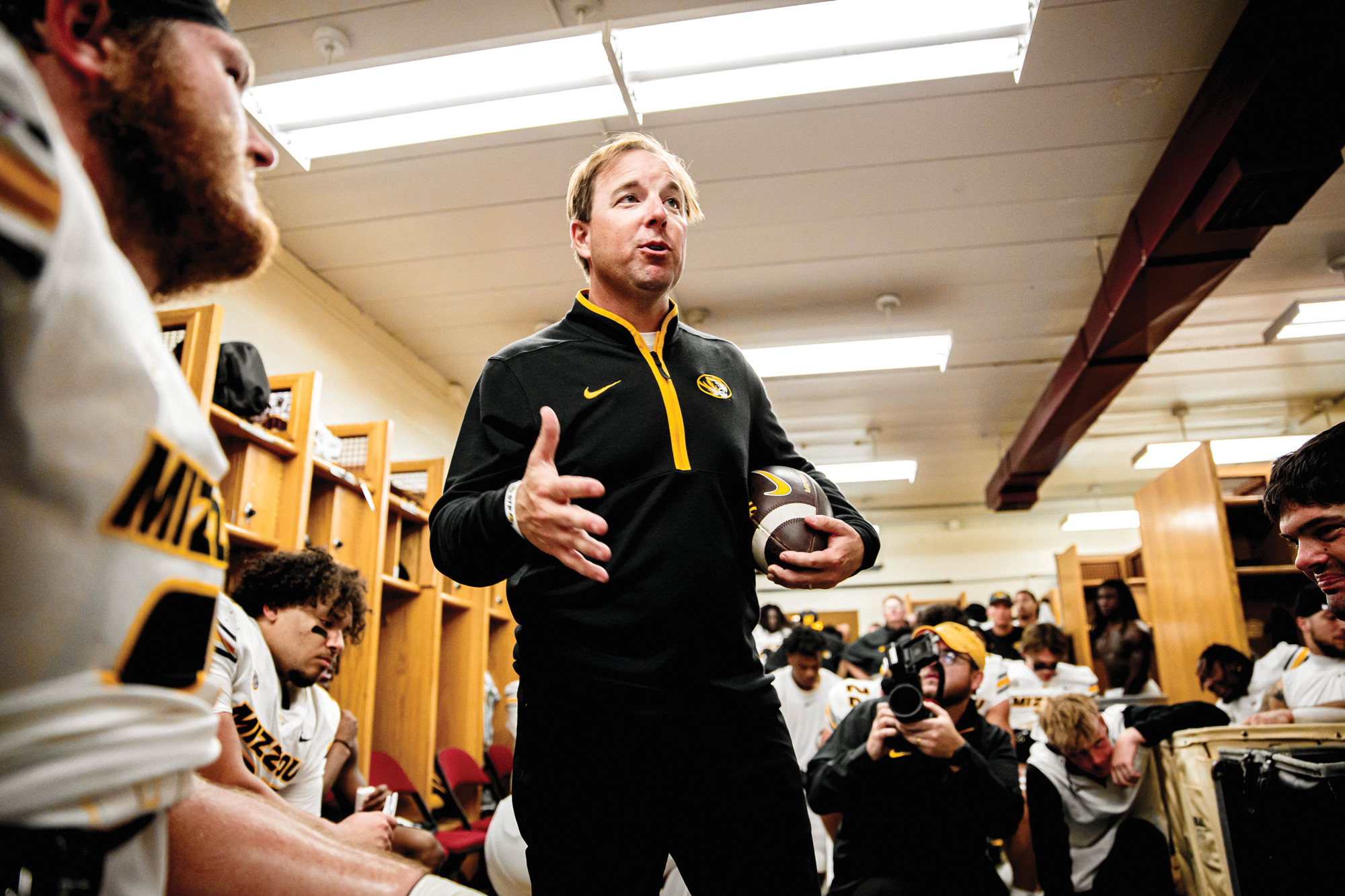
Steelwork
Dynamic is the word University of Missouri President Mun Choi used more than once in describing what he remembers about Drinkwitz when Mizzou was in the market for a football coach. “He didn’t try to sell us,” Choi says. “He just came across as being very dynamic, diligent and genuine.”
In Choi’s view, not much has changed since that initial meeting. Drinkwitz, he says, wants to know what’s happening on the academic front and around campus, how he can help and what he can do. He seems to pop up everywhere: at sporting events, at alumni gatherings, at a meeting of construction workers at Faurot, you name it. Every interview and every address is punctuated by an “M-I-Z” signoff. He has become the face of the university.
“I see him as someone who understands the importance of athletics and advancing the university,” Choi says. “He talks to me about the importance of a nuclear research reactor and the fact we are an AAU institution. This demonstrates to me he is part of our organization, not just the coach for football.”
That inquisitive nature drives Drinkwitz in his never-ending quest to experience something new. In 2025, he took his juniors and seniors on a service trip to a mountain village in Jamaica for several days of home- and team-building. This spring he cleared his mind with a 22-mile e-bike trek through the Red Rock Canyons outside Las Vegas. “It was just something unique outside of football,” he says. “I’d never done anything like that. I got to see some beautiful artifacts, beautiful country. I pride myself on trying to do things I haven’t done before.”

Whether he’s speaking to an alumni group or a gaggle of reporters, Drinkwitz has never shied away from the microphone. He believes having a sense of humor helps, and he’s not afraid to stick out his neck with a joke here and there. “Sometimes they land, sometimes they don’t,” he says. “You can’t be afraid when it fails.” Over the course of a couple of days in May at the SEC spring meetings, he addressed a variety of hot topics. His remarks spread like wildfire across social media. Among other things, he:
• Took Big Ten coaches to task for their opposition to the newly adopted punt-formation rules. “Complain about something that you could have been a process to. Maybe they find a local judge to allow them to use whatever process they use.”
• Showed he deals with everyday headaches just like the rest of us. He noted on Sirius XM radio that despite falling two votes shy in his battle with his homeowners’ association to get a fishing ban lifted at a neighborhood pond, he wasn’t giving up the fight. “We didn’t have enough turnout. The absentee ballots kill you. Next year I’ve got to plan for that.”
• In an apparent acknowledgment to critics who say he needs to start winning more big games, jokingly told Paul Finebaum of SEC Network that he might be headed to a career in media. “If we don’t start beating Top 25 teams, they’re going to start putting my ass on TV.”
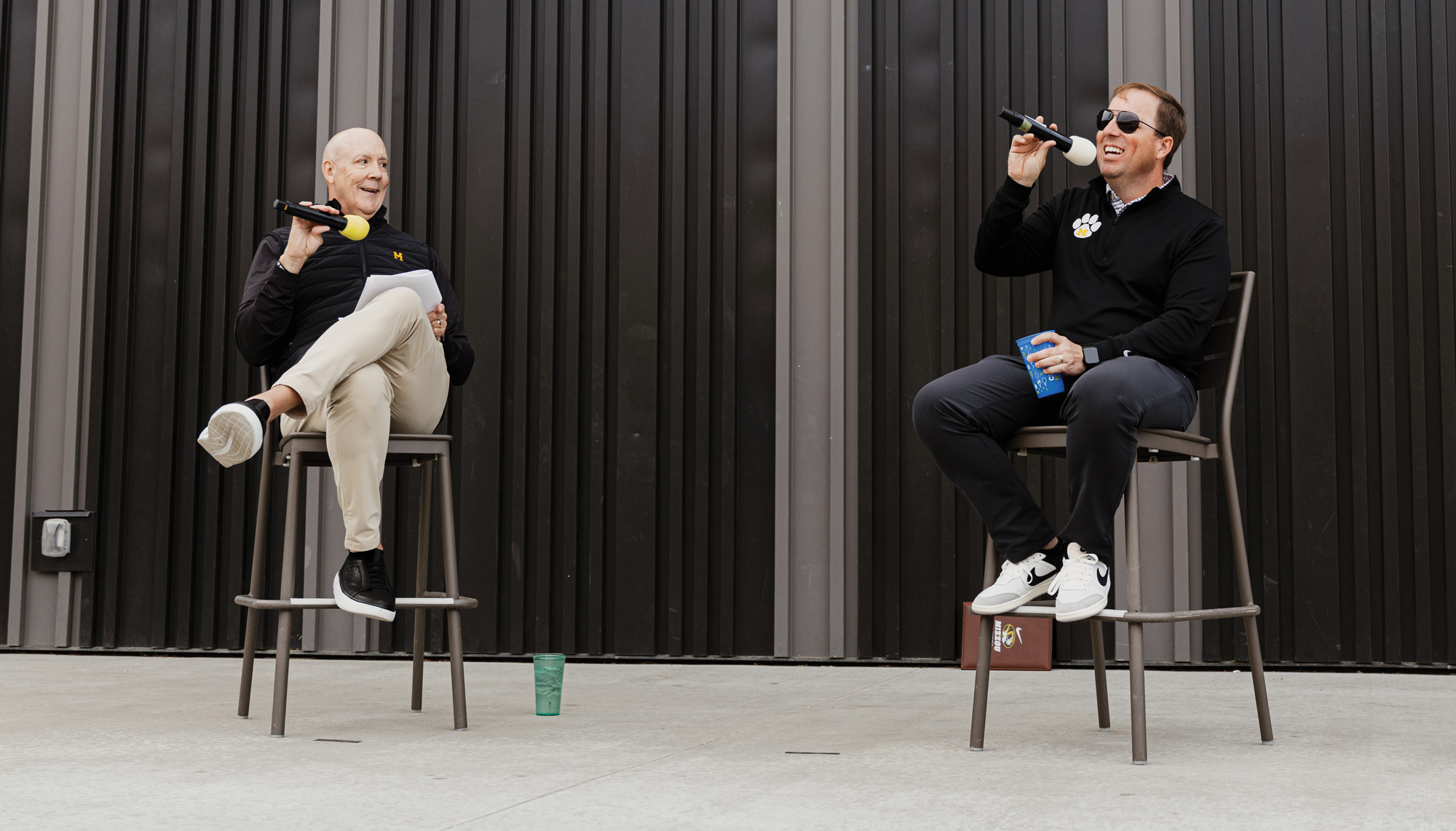
In the end, of course, that’s what it all comes down: the wins and losses. So, no surprise, the deep desire to learn more extends to Drinkwitz’s day job.
“I think curiosity is the only way to improve,” he says, “and I’ve always wanted to improve, get better, to accomplish more, to keep winning. The day you think you got all the answers is when you start losing.”
“I think you have to be inquisitive, you’ve got to want to learn,” he adds. “You’ve got to be able to spread your wings, so to speak, to try to fly. You have to get some knowledge in order to do that.”
Case in point: Last year, Drinkwitz wavered about what to do at quarterback and waited until fall camp to name a starter. Granted, injuries would become a factor, but the QB play was indifferent at best, and Mizzou lost a couple of games it was in position to steal. Lesson learned. This year, Drink not only locked up the quarterback he wanted early in the portal season, but he also named Austin Simmons the starter during spring ball.
“We knew Austin Simmons was here to be our starting quarterback, to give us the best chance to find success,” Drinkwitz says. “We need to allow him to grow his leadership with our team but also allow our offense to be developed around him and his strengths.”
Horizons
Drink has thrived in the transfer portal by identifying holes on the roster and then finding players who can fill them. As evidence, every one of the program-record-tying-high six Tigers who were selected in the 2026 NFL Draft was a portal addition. Simmons, who lost the starting job at Ole Miss to an ankle injury early last season and never got it back, is mature beyond his years. He graduated from high school two years early and earned his bachelor’s degree at the age of 19, three months before he had started a game at Ole Miss.
The emphasis in the passing game will be to push the ball deeper down the field. Simmons’ arm talent stood out to Drinkwitz; he’s a former pitcher who can sling it. But that’s not all.
“I like that he’s still young from a learning standpoint and that he’s hungry to improve and get better,” Drinkwitz says, “and then like anybody we bring in our program, guys with a chip on their shoulder, with something to prove, have traditionally panned out really well for us. He’s got the right kind of chip on his shoulder.”
Bringing in a transfer at the game’s most important position comes with risks. What makes this situation even more of a challenge is that Simmons is left-handed. That can affect play-calling and the comfort of the quarterback rolling one way versus the other. The right tackle is now the blind-side protector. The ball comes out of the quarterback’s hand with the opposite spin, which will be an adjustment for every receiver not named Cayden Lee, a fellow Ole Miss transfer and Simmons’ best friend. Drinkwitz can’t recall coaching a lefty QB, but the good news is that Lindsey has such experience, having worked with Max Johnson during a recent stop as the offensive coordinator at North Carolina.
As Richards notes, in Chapel Hill, Lindsey also was involved in the development of Drake Maye, a future first-round NFL draft pick who sang the praises of his offensive coordinator and who, in only his second pro season, had a breakout year with the New England Patriots in 2025. Richards also points to Drink’s track record in the portal.
“Whatever he’s doing to identify talent, he’s been very good at filling the holes,” Richards says. “The guys he brings in are as good if not better than what he’s had before. The development piece has to happen. How does a new guy come in and adjust to the system? How fast can he learn? For the most part, I think they’ve been successful.”
What’s not to like? With 29 wins over the past three seasons, Mizzou is tied for 12th among Power Four conference schools. Choi mentions the four straight years of record applications and a steady rise in enrollment, increases that are largely tied to success on the football field. In his travels around the country and abroad, Choi says alumni and fans want to talk about Mizzou football. The unveiling of the north end zone complex will coincide with the Memorial Stadium centennial celebration. It is all happening under the direction of a football coach who is where he wants to be and believes he can win here. And win big.
“Every day, you’ve got to have a little bit of success,” Drinkwitz says, “and over time, you stack it up, and you look back and you say, ‘OK, this is how far we’ve come.’ That’s what’s happened with us. It started with a vision of trying to get lights on the practice field. And then it was getting an indoor facility, and then it was redoing the weight room and recovery room and investing in our athletes. And then it was having a bigger vision of what we want to do with the north end zone.”
It wouldn’t be wrong to say that, on the football field and off, a little is quickly becoming a lot.
To read more articles like this, become a Mizzou Alumni Association member and receive MIZZOU magazine in your mailbox. Click here to join.