April 21, 2026
Contact: Janese Heavin, heavinj@missouri.edu
At the University of Missouri, names connect generations, linking moments and memories with vision and progress.
Ellis isn’t just a library. It’s where quiet determination led to a dream career. Faurot isn’t just a field; it’s the tackles, touchdowns and traditions carried on by players who never met Coach Don Faurot but still feel the impact he had on the game.
Over time, names have become part of the language of campus life.
Some belonged to educators, others to public servants, but all of the names belong to those who invested in the future of the university. Meet 10 men and women whose names are part of the legacies woven into the fabric of Mizzou.
University leaders
Elmer Ellis
By midterms, most students know where their spot is inside Ellis Library. Some claim quiet corners; others huddle around tables for groupwork. Across generations of Tigers determined to ace their classes, the Ellis name has become shorthand for ambition.
Mizzou’s central library opened in 1915, a decade before Elmer Ellis joined the faculty. But his long tenure of service and leadership sealed his spot in university history.
After serving as dean of the College of Arts and Science, Ellis became president in 1955 and guided Mizzou for more than a decade, eventually becoming the first president of the University of Missouri System when its four campuses were unified in 1963.
In 1971, the university renamed the building to celebrate Ellis’ belief in the power of education. Today, every late-night study session in Ellis Library carries that commitment forward.
Eva Johnston
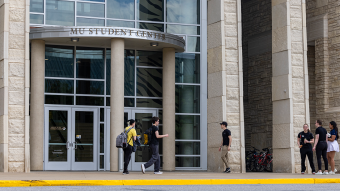
Each year, hundreds of Tigers move into Johnston Hall, a popular residence hall for women. The building is in close proximity to amenities such as MizzouRec and the Mizzou Student Center, making it easy for residents to get involved, stay active and feel connected.
It’s a fitting tribute to Eva Johnston, a pioneer who expanded opportunities for women at Mizzou.
A Missouri native, Johnston studied at the university before continuing her education and earning a doctorate abroad. She later returned to campus as a professor of Latin and became Mizzou’s first dean of women, guiding students as they navigated new academic and social freedoms.
Johnston Hall opened in 1947 — six years after her death — ensuring that her commitment to student life would remain part of the university she helped shape.
Champions of campus life
Don Faurot
On Saturdays in the fall, the moment arrives when the Tigers charge onto the field, and unified voices echo across the stadium.
Don Faurot knew that feeling well.
A Mizzou football player in the early 1900s, Faurot returned decades later as head coach, introducing innovative offensive strategies that helped influence modern football. After leading the program for 19 seasons, Faurot became Mizzou’s athletic director.
In 1972, the university named the playing field in his honor. More than half a century later, the Tigers still compete on a foundation shaped by his leadership and vision.
Carrie D. Francke
Drivers crossing campus on Carrie Francke Drive might not know the story behind the name, but it reflects a life defined by talent and ambition.
Carrie D. Francke made the most of her time at Mizzou. She double majored in journalism and political science, performed with Marching Mizzou and became the first woman elected president of the Missouri Students Association.
After graduation, her career quickly moved into national politics. She worked for U.S. Sen. John Danforth and later for Missouri Attorney General John Ashcroft, emerging as a rising voice in the Republican Party.
In 1989, shortly after being appointed to the University of Missouri Board of Curators, Franke died in an accident on Interstate 70.
The drive that bears her name is a reminder of the motivation she brought to Mizzou and the leadership that continues to inspire those who follow.
Mary Louise Gillett
For many students, Gillett Hall is where Mizzou memories take root. Residents gather in its courtyard, study late into the night and form friendships that last long after graduation.
The hall is named for a trailblazer who helped make those experiences possible.
Mary Louise Gillett became the first woman to graduate from the University of Missouri in 1870 at a time when colleges were beginning to open their doors to women. She enrolled in the university’s Normal School, a teacher-training program established as Mizzou rebuilt after the Civil War.
After graduating, Gillett taught in Hannibal before returning to the university to help train future educators. Today, she’s remembered both within the College of Education and Human Development and by those who call Gillett Hall home.
Innovation and impact
Robert J. Trulaske, Sr.
At the Robert J. Trulaske, Sr. College of Business, students prepare for careers that will take them into boardrooms around the world.
Robert J. Trulaske, Sr., BS BA ’40, sat in those spaces, too. After graduating from Mizzou, he founded True Manufacturing Company, now a global leader in the refrigeration industry.
Trulaske’s success fueled his investment in the university. Through an endowment supporting scholarships, Trulaske helped ensure that future students would benefit from the same education that launched his career.
In 2007, the college was renamed the Robert J. Trulaske, Sr. College of Business in honor of his support and his deep commitment to paying it forward.
Today, every Trulaske graduate is an extension of that legacy.
F. Robert and Patricia Naka
Inside Naka Hall, electrical engineering and computer science students design systems, test ideas and explore technologies that could shape the future.
That’s exactly the path Robert Naka, BS EE ’45, followed after graduating from Mizzou.
Naka enrolled in Mizzou’s College of Engineering after being released from a California internment camp for Japanese Americans during World War II. He went on to become a pioneer in stealth technology, significantly advancing U.S. military capabilities.
During the Cold War, Naka’s work helped develop systems that allowed U.S. aircraft to evade radar. He later served as the 20th chief scientist of the U.S. Air Force.
Robert Naka and his wife, Patricia, supported Mizzou throughout their lives, establishing an endowed professorship and funding scholarships and academic programs.
In 2016, the university renamed Engineering Building West in the couple’s honor, and today, Naka Hall is a place where innovation continues to thrive.
Service to Missouri
John K. Hulston
In Hulston Hall, Mizzou law students analyze precedent, argue cases in a mock courtroom and prepare for careers in law and public service — many hoping to follow in the footsteps of John K. Hulston, JD ’41.
After graduating from Mizzou, Hulston served as a major in the U.S. Army during World War II before opening a law practice in Springfield, Missouri. He was also active in politics and business, including serving on the board of Ozark Airlines until it was acquired by TWA.
Beyond his career, Hulston was widely recognized for civic leadership and historic preservation. He and his wife, Ruth, were instrumental in establishing the library at Wilson’s Creek National Battlefield.
Today, his name is synonymous with the professional excellence that defines Mizzou’s School of Law.
Mel Carnahan
Students crossing Carnahan Quadrangle often pause to greet friends, relax between classes or snap a photo with the bronze tiger on Tiger Plaza.
The quad was renamed in 2002 to honor Mel Carnahan, JD ’59, whose life was defined by service to Missouri.
After graduating from Mizzou, Carnahan entered public life early, serving as a municipal judge, state representative, state treasurer and lieutenant governor before being elected Missouri’s governor in 1992. As his second term neared its end, Carnahan died in a plane crash while campaigning for the U.S. Senate.
The quad that bears his name celebrates his commitment to the state and the people he served.
Charles and Josephine (Josie) Smith Sinclair
The Sinclair School of Nursing is known for preparing nurses, educators and researchers with the skills needed to strengthen health care systems and improve lives. Using lifelike simulation equipment in labs designed to mirror real hospital settings, students build clinical judgment skills and the confidence required for today’s complex care environments.
That hands-on approach reflects the values of Charles and Josephine (Josie) Smith Sinclair, Boone County farmers who understood the importance of skilled, compassionate nursing care. After receiving in-home nursing care, the Sinclairs chose to invest in the future of the profession. Following their death, they left a substantial endowment to the university with future nurses in mind.
Their gift continues to strengthen the school and advance nursing education today.
An ongoing story
Across campus, names appear on buildings, streets, quads and plaques. Students pass them every day.
Behind each one is the story of someone who believed in the university’s future. And every incoming class of Tigers brings new opportunities to celebrate those legacies and add new chapters to the story of Mizzou.