Sept. 21, 2026
Contact: Cary Littlejohn, carylittlejohn@missouri.edu
Photo by Gina Beebe
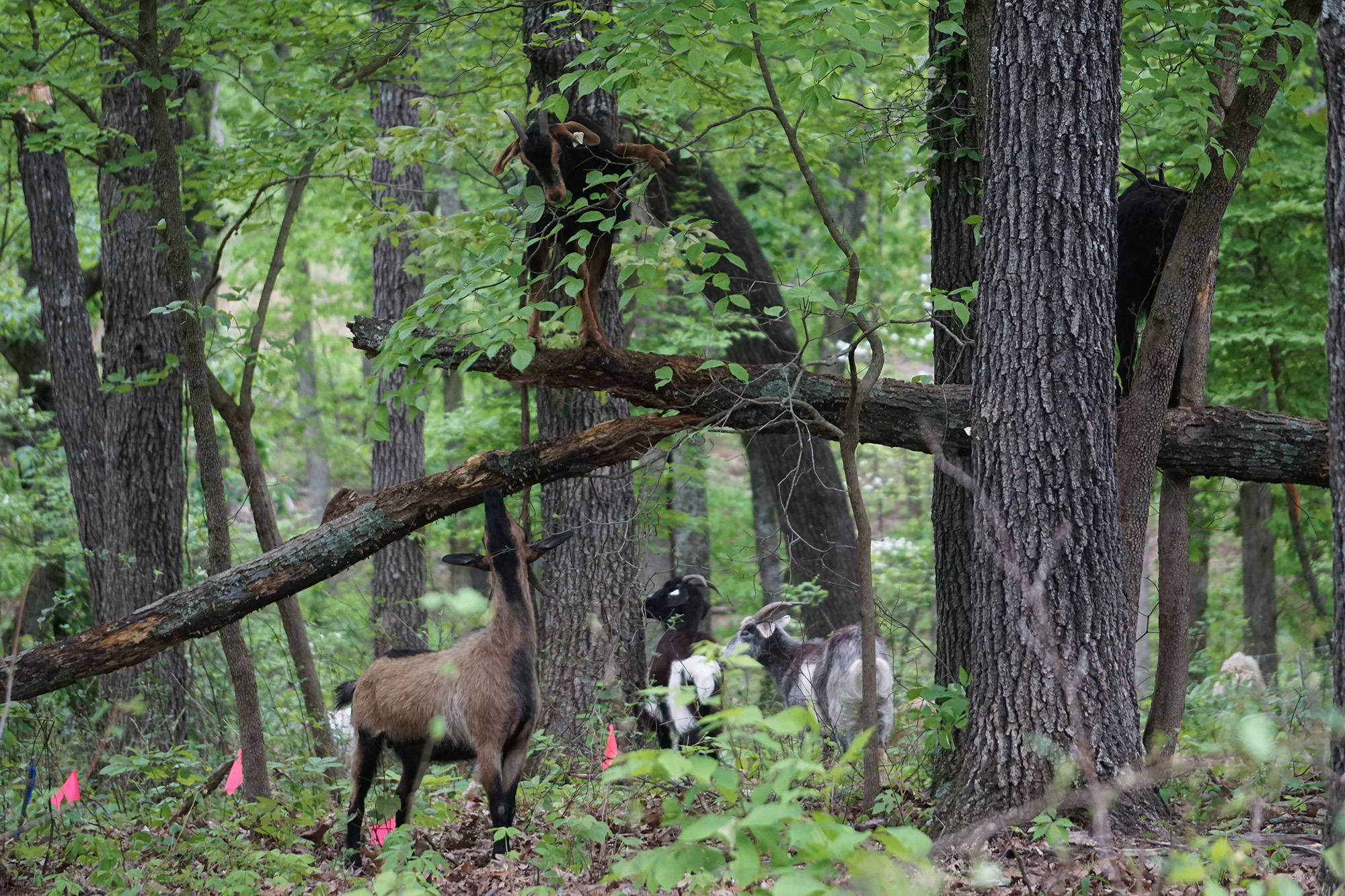
University of Missouri researchers have found an unlikely ally in the effort to restore Missouri's oak woodlands: goats.
Gina Beebe, a Mizzou doctoral student in the College of Agriculture, Food and Natural Resources, led a three-year study in the Mark Twain National Forest that found carefully timed goat browsing can improve forage for livestock while maintaining the ecological health of native woodlands. The findings offer private landowners a new way to restore forests while creating opportunities for agricultural production.
Goats are natural browsers that prefer woody plants over grasses, making them well-suited for overgrown forests. They readily consume invasive shrubs such as honeysuckle and multiflora rose, helping clear unwanted vegetation while allowing native plants and desirable forage species to recover.
The research, which was supported by the U.S. Department of Agriculture Forest Service and Mark Twain National Forest, is especially relevant in Missouri, where roughly 83% of forested land is privately owned. Many landowners want healthier woodlands but lack practical ways to offset the costs of restoration. Targeted browsing offers one potential solution. This management approach creates conditions that can support woodland restoration efforts and silvopasture – an agricultural system that integrates trees, forage and livestock.
Among the management approaches tested, spring browsing proved most effective for silvopasture systems. Goats browsing in the spring encouraged nutritious grasses and legumes while reducing competing plants, creating a forage mix well suited for livestock production.
Just as importantly, the researchers found that livestock browsing did not reduce the woodland's overall ecological quality.
"There has been a stigma against putting livestock in the woods, and these results showed that goats didn't destroy the place," Beebe, a research and education specialist at Mizzou’s Center for Agroforestry, said. "I think this notion that livestock browsing in woodlands is bad isn’t always true. This is great news because we, as a state and country, don't have enough boots on the ground to manage all the woodland acreage. This study suggests that we can integrate our livestock into our conservation efforts, and everyone wins."
A complement to prescribed fire
The findings address a challenge that has been decades in the making.
Much of Missouri's oak forest regenerated after widespread logging and agricultural clearing in the early 1900s. Since then, decades of fire suppression have allowed dense shrubs and young trees to fill the forest understory, crowding out many of the native grasses and wildflowers that once thrived there.
Prescribed fire remains the most effective tool for restoring these woodlands, but it can be difficult to use consistently.
"There's a limited window to actually burn," Beebe said. "In this part of the world, we pretty much only burn in the late fall to early spring, and then you only have a few days in that window when it's not raining or snowing or too windy to burn safely."
Healthy oak woodlands depend on periodic disturbance to prevent woody vegetation from taking over. Beebe began wondering whether another natural disturbance could help fill that role.
"This work was inspired by the question, 'What can we use instead of fire?'" Beebe said. "The answer was goats. Both fire and goats eat vegetation."
To reach that conclusion, researchers compared several management strategies, including spring browsing, fall browsing, dormant-season plus fall browsing, prescribed fire and combinations of browsing and fire.
The study found that different management practices serve different purposes.
Prescribed fire remained the preferred option when restoring native woodland ecosystems was the primary goal, increasing native woodland plants and overall plant diversity while reducing dense woody growth.
Targeted spring browsing, meanwhile, offered the greatest promise for developing silvopasture systems by improving forage without sacrificing ecological integrity. The researchers also found that seasonal goat browsing can help create healthier habitat for wildlife by encouraging a more diverse and open woodland structure.
Rather than competing approaches, the findings suggest prescribed fire and targeted goat browsing can serve as complementary tools. Together, they give landowners more options for restoring Missouri's woodlands while supporting both conservation and agricultural production.
The study “Goats and oaks: applicability of targeted browsing to promote forage quality and conservation outcomes in woodland communities in the Central Hardwood Region of the United States” was published in Agroforestry Systems. Co-authors are Michael Stambaugh at Mizzou; Lauren Pile Knapp, Connor D. Crouch, Dacoda Maddox and Daniel C. Day at the USDA Forest Service Northern Research Station; and Brian Davidson at the Mark Twain National Forest.