June 10, 2026
Contact: Eric Stann, StannE@missouri.edu
Photos by Koden Lam
At the University of Missouri, students are learning fashion design through the lens of everyday life: how people live, move and navigate the world around them.
That user-centered mindset shows up every day across Mizzou’s Department of Textile and Apparel Management. By working closely with people who have disabilities, students are engaging in a more thoughtful, collaborative process that reflects real experiences.

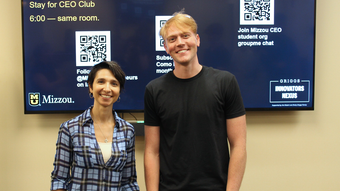
Mackenzie Miller, center, created a new adaptive apparel class this semester in Mizzou’s Department of Textile and Apparel Management.


Designing with, not for
Mackenzie Miller, a doctoral candidate in Mizzou’s College of Arts and Science, is helping students rethink how clothing should work, starting with the people who wear it. Her goal is to ensure that people with disabilities can get dressed in the morning feeling like themselves.
“For many people, getting dressed is a simple part of the day,” she said. “But for someone with a disability, features such as buttons, zippers and stiff fabrics can make this process frustrating or even impossible. Adaptive clothing reimagines those features — prioritizing dignity, comfort and ease of use without sacrificing personal style.”
That idea is at the center of a new adaptive apparel course Miller created this semester, bringing together undergraduate and graduate students from textile and apparel design, occupational therapy and health sciences. In the course, students learned to recognize that hard-to-use fasteners, uncomfortable fabrics or poorly fitting garments are design issues, not user shortcomings.
"I started the class to help make sure people with different needs can find clothing that makes them feel confident and comfortable," she said. "I also wanted students to develop an understanding of disability by working directly with community members. Disability touches all our lives in some way, and I think we can all be more thoughtful about giving people choices in what they wear."
Instead of designing for the community members, students designed with them. The volunteers shared their daily experiences, needs and preferences, guiding the design process from start to finish. Using interviews and observations, students worked in small teams to develop clothing tailored to each person. Their projects included developing shirts with magnetic closures for a wheelchair user, and custom mittens designed for someone living with rheumatoid arthritis.
Miller’s interest in adaptive design grew from personal experience. Years ago, a close friend who used a wheelchair struggled to find professional clothing that fit her body and reflected her personal style. As Miller helped alter garments for her friend, she began to see fashion as a tool for access and dignity.
Miller came to Mizzou in 2021 to work with Kerri McBee‑Black, an assistant professor and nationally recognized expert in adaptive apparel design. With McBee‑Black’s mentorship, Miller saw an opportunity to build a course that connects students’ technical skills with real, unmet needs in the community.
“By the end of the semester, students leave with more than finished garments,” Miller said. “They gain a new way of thinking — rooted in listening, collaboration and problem solving — around something we all do every day: getting dressed. And they carry that perspective into every design decision they make after graduation.”

Designing beyond the classroom
That same focus on designing around real users also shaped senior Teaghen Speier’s work with the Mizzou Wheelchair Basketball team.
For most people, carrying a backpack or gym bag doesn’t require much thought. But for people who use wheelchairs, poorly designed bags can create real challenges. Long straps can get caught in wheels, uneven weight can cause strain and hard-to-reach pockets can make everyday tasks more difficult. Adaptive design addresses these issues by changing the product.
While working with the team, Speier noticed a clear pattern: standard backpacks simply didn’t work. The student athletes described having hard-to-reach pockets, or materials that were worn down easily due to the placement on the chairs.
Instead of starting with a redesign, Speier began by listening. She observed how he moved and asked questions about how he used his gear.
“The biggest issue was the position,” Speier said. “So, I moved it from the back of the chair to underneath the seat.”
Her design is a backpack that sits securely under the wheelchair seat, staying out of the way while remaining easy to access. The bag includes a laptop sleeve, water bottle pockets and elastic loops that keep straps away from wheels. Made from durable, weather-resistant material, the bag is angled to fit a variety of wheelchair frames.

Speier developed the project in one of McBee‑Black’s technical design courses. Through a partnership with an adaptive apparel company, her design was selected to be made into a full prototype. She recently received the trial version and has been wear-testing it with members of the wheelchair basketball team.
Working with professional design software, manufacturers and real production timelines gave Speier valuable insight into how design ideas become finished products and how those products affect people’s daily lives.
“Before this project, everything felt very fashion-first,” Speier said. “Now I really value designing around how something actually works for someone and seeing the difference that can make.”
That shift didn’t happen overnight. Growing up in a military family and moving nine times, Speier learned early on how much clothing can support identity, stability and self-expression. When choosing a college, she looked for fashion merchandising programs with strong industry connections — and found more than she expected at Mizzou.
“Mizzou was the last campus I toured, and it immediately felt different,” she said. “Meeting one-on-one with a professor and talking through career paths made it feel personal. I don’t think I would have discovered my passion for user-centered design the same way anywhere else.”