Sept. 22, 2026
Contact: Brian Consiglio, consigliob@missouri.edu
Photo by Ben Stewart
A groundbreaking discovery at the University of Missouri could help older adults maintain the muscle strength they need to stay active and independent, whether that means safely crossing the street or playing with their grandchildren.
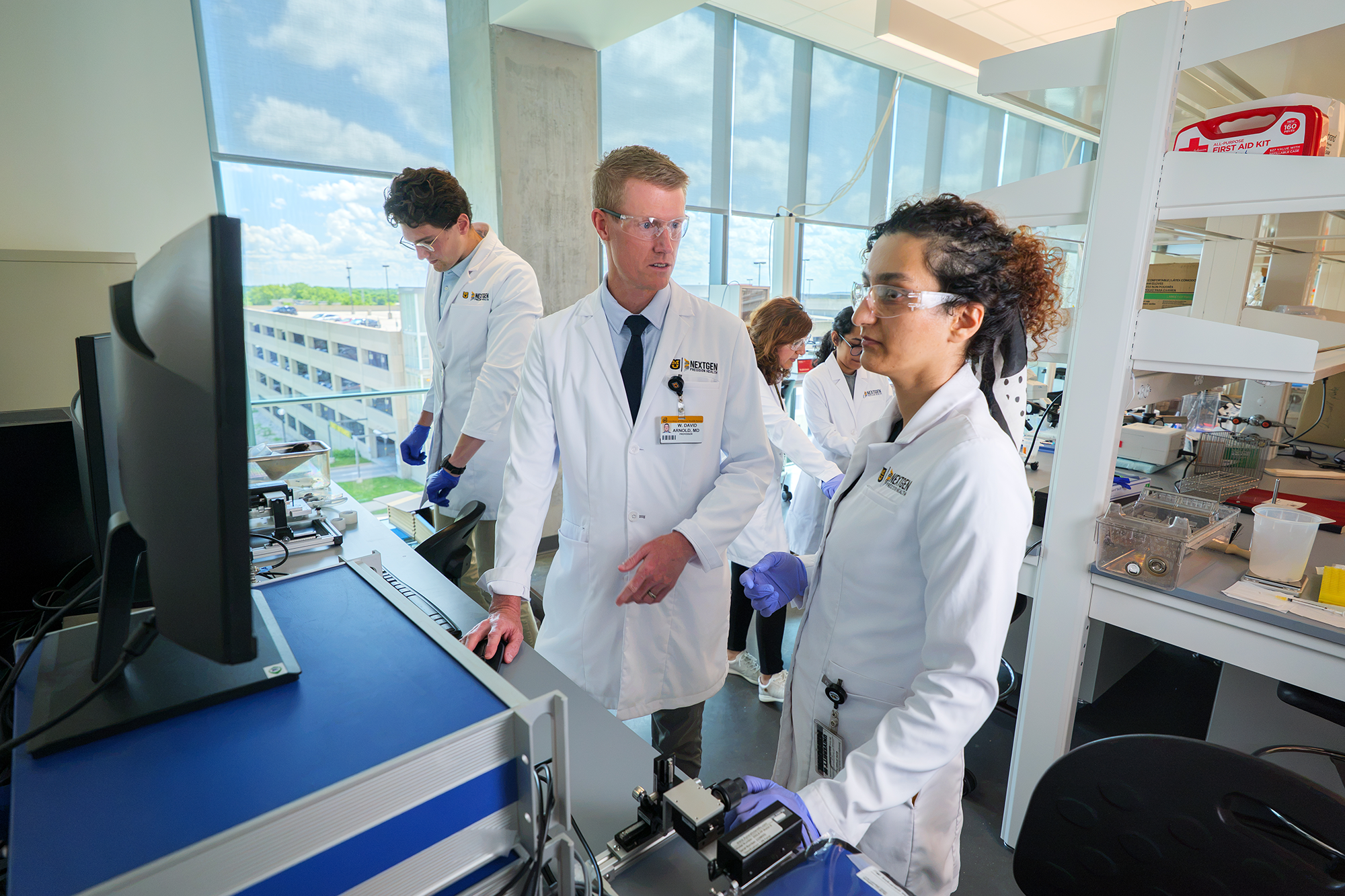
W. David Arnold, the executive director of the NextGen Precision Health initiative, and his collaborators discovered that a previously unrecognized breakdown in the communication between nerves and muscles contributes to age-related muscle weakness, also known as sarcopenia, which affects nearly half of adults over age 80.
The researchers also identified a protein that could be targeted to improve muscle strength, offering hope for those who have assumed a decline in muscle strength is simply an inevitable part of aging.
“While the human lifespan has increased in recent decades, our ultimate goal at Mizzou is to ensure a person’s health span remains as high as possible for as long as possible,” Arnold, a professor in the School of Medicine, said.
Scientists have long sought to understand what causes muscles to weaken as people age. One theory has focused on changes happening within the muscles themselves, most notably the loss of muscle mass. Researchers have also studied the loss of neurons that send messages telling muscles to move.
But Arnold wondered if something else was happening between the two.
For more than a decade, Arnold has studied the neuromuscular junction — the point where a nerve communicates with a muscle to make it contract. Normally, this communication is reliable, allowing signals from nerves to consistently trigger activation of muscle fibers.
Arnold’s research found that this communication becomes less effective with age due to reduced levels of a protein called NaV1.4.
“A long-held assumption in the field was that the neuromuscular junction remains reliable during aging, and some even suggested it may get better with aging,” Arnold said. “The significance of this new study is we are showing, in both humans and in animal models, that the neuromuscular junction is failing with aging.”
The discovery also gave Arnold and his team a potential target for restoring some of that lost muscle function.
“We identified an important point of failure at the final step in communication between nerves and muscles,” Arnold said. “And what is perhaps even more exciting is that we showed this failure is potentially reversible. In collaboration with NMD Pharma, a biotechnology company in Denmark, we applied an approach they developed that targets a protein called ClC-1. By partially inhibiting ClC-1, we were able to make aging muscles more responsive to nerve signals and improve muscle strength in an animal model. That gives us a potential path toward eventually testing this approach in older adults.”
Turning discoveries into treatments
There is already evidence from clinical studies that targeting ClC-1 can improve aspects of muscle strength and function in people with neuromuscular disease, although those studies have focused on different conditions.
Arnold was an investigator in a multicenter clinical trial of ignaseclant, a drug candidate developed by NMD Pharma that partially inhibits ClC-1, in patients with Charcot-Marie-Tooth disease, the most common inherited neuromuscular disorder. The study found improvements across several measures of muscle strength and function, and Arnold presented the topline results at the 2026 Muscular Dystrophy Association Clinical & Scientific Conference.
Arnold is optimistic that ignaseclant could eventually help older adults with sarcopenia.
“I realized that in order to make a drug widely available to treat sarcopenia, the first step is better understanding what is causing sarcopenia in the first place,” Arnold said. “That curiosity sparked my interest in becoming a researcher.”
The work has brought together expertise from around the world. Arnold leads an international team of scientists and clinicians from Denmark, Scotland, Saudi Arabia and India. At Mizzou, he has also recruited researchers to the Roy Blunt NextGen Precision Health building, including Hiroshi Nishimune, an internationally renowned expert in neuromuscular junction research and co-author on the new study.
“When he came to Mizzou from Tokyo to join our lab, his specialized imaging expertise helped us start to answer questions that previously seemed out of reach,” Arnold said. “He’s really one of the top experts in the world when it comes to the neuromuscular junction, and it definitely gives us an edge here at Mizzou for pioneering innovative work in this field.”
The study, “Neuromuscular junction failure in sarcopenia is linked to NaV1.4 loss and reversed by ClC-1 inhibition,” was published in The Journal of Clinical Investigation.