By Liz McCune
Sept. 29, 2026
Photo by Delainey Seibert
Artificial intelligence can write your email. Build your presentation. Generate your ad campaign. Summarize your reading. And, increasingly, produce an endless supply of perfectly adequate content.
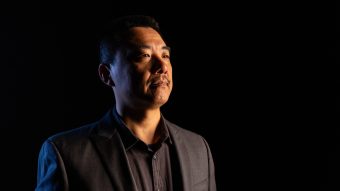
Anuj Kapoor has been studying what happens when AI meets human behavior. An assistant professor of marketing at the University of Missouri’s Robert J. Trulaske, Sr. College of Business, Kapoor’s research interests include digital video advertising, AI-human interaction and digital platforms.
In a recent field experiment involving more than 21,000 consumers, Kapoor and his fellow researchers found that personalized video advertisements created with generative AI generated greater engagement than more traditional digital advertising formats.
So, if everyone has access to the same powerful AI tools, what makes you valuable?
Here’s what Kapoor has to say about AI slop, good judgment and why struggling with a blank page might be more important than students realize.
As AI-generated content becomes easier and cheaper to produce, does distinctly human work become more valuable?
Yes, and I would put it more strongly.
Picture a machine that can draw a thousand clean, pretty pictures in a minute. Once that exists, an OK picture is worth almost nothing because everyone has the machine and all the pictures start to look the same. What people still pay for is the picture only you would have thought of.
The model gives you the average good answer, so the average is now free. Everything that stands out has to come from the part the model cannot reach, which is the part that is actually you: a real point of view or a detail about a specific customer that was never sitting in the training data.
In my world, a thousand brands can generate the same on-trend caption by lunchtime. The ones that are successful sound like a person who has actually met the customer and is willing to be a little sharp about it.
The machine can copy what already exists. It cannot be you.
If every graduating student can use ChatGPT, Claude and other AI tools, what will distinguish the students employers really want?
Imagine every student is handed the same calculator. Being able to press the buttons does not make anyone special because everyone can press the buttons.
What makes a student valuable is knowing when the answer on the screen is silly. If the calculator says one slice of pizza costs a million dollars, you want to be the person who says that is wrong.
AI is like that. It will give you a confident answer, and the rare skill is catching the moment it is confidently wrong. That takes real knowledge of the business, which a prompt cannot hand you.
The students who can do the underlying work without AI end up being the best at using it because they can see where it went off the rails. A student who never learned to write cannot tell good writing from AI slop, so the tool quietly makes the work worse while they think it is making it better.
Do students risk losing important skills if they rely too heavily on AI?
Yes, and the worry is specific. The skills most at risk are the boring, hard ones because those are exactly the ones students are quickest to hand off.
The blank page. The problem you cannot crack for 20 minutes. That stuck feeling is not a sign something has gone wrong. It is the exercise. It is the mental version of lifting something heavy, and the strain is the whole point.
Writing is the clearest case because writing is how you find out what you actually think. Hand it off and you never form the thought. You just receive one.
So the order matters. Do the heavy lifting yourself first, then use the tool to go faster.
The problem is not that students use AI. It is that many reach for it before they have built the muscle to judge what it gives back, and by then the muscle they skipped never grew.
What do today’s students need to understand about AI that they may not fully appreciate yet?
The first thing is uncomfortable. The model is basically everyone’s average blended together, so if your work sounds like the model, you have quietly told the world you are easy to swap out for it.
Be the part that is only you.
The second is that responsibility does not move to the tool. If the machine does the work and the work is wrong, it is still your name on the page, and you are the one who gets asked about it. “The AI said so” has never once sounded good in a room that mattered.
And people assume AI is a great equalizer that lifts everyone the same, but it gives the biggest advantage to the people who already know what they are doing.
Simply knowing the standard answer will be worth very little because the machine will know it, too. What holds its value is the nerve to bet against the standard answer and the discipline to actually pull the bet off.
Those are two things the machine cannot copy.
Read more from the Trulaske College of Business