January 7, 2026
Contact: Brian Consiglio, consigliob@missouri.edu
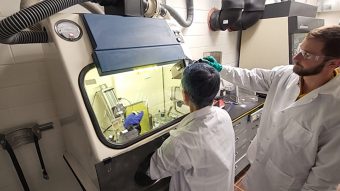
Photo by Abbie Lankitus
To determine who could benefit from targeted cancer treatments, a researcher at the University of Missouri is putting tumors under the spotlight.
In a recent study, Barry Edwards, an associate professor of biochemistry in the School of Medicine, created a tiny antibody designed to seek out and attach to EphA2, a protein commonly found in cancerous tumors. He then added a radioactive tag to the antibody, allowing it to light up on a positron emission tomography (PET) scan.
In a mouse model, Edwards demonstrated that this cancer-detecting “flashlight” glowed brightly on tumors that expressed EphA2. This means that tagging the antibody could help detect cancer and identify which patients are most likely to benefit from emerging treatments designed to target EphA2-positive tumor cells while sparing healthy tissue.
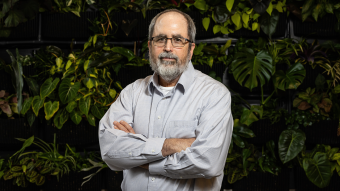
“By finding out which patients have high or low amounts of EphA2, we can determine who is most likely to benefit from a targeted cancer treatment,” Edwards, who also has an appointment in the College of Arts and Science, said. “There is no sense in giving a treatment that won’t work to a patient, so this new process we created saves time and money while advancing precision medicine.”
Currently, physicians rely on biopsies and MRIs to assess tumors in cancer patients, but these techniques can be invasive, time-consuming and limited in the information they provide about specific proteins within cancer cells. Edwards — who uses state-of-the-art imaging equipment at Mizzou’s Molecular Imaging and Theranostics Center for his research — hopes to move this innovation from preclinical models to human clinical trials within seven years to provide a better method.
“This new targeted approach is noninvasive, and you can get results from the imaging in hours rather than days, which can be huge for patients traveling long distances to seek treatment,” Edwards said. “By making the process easier and faster for both patients and clinicians, we’re showing that precision medicine is a win-win.”