Contact: Sara Diedrich, diedrichs@missouri.edu
May 4, 2026
Photos by Abbie Lankitus
Step inside a faculty office at the University of Missouri, and you’ll often find a story waiting to be told. The spaces that faculty occupy and the objects they collect reveal personalities and passions that shape their teaching.
At Mizzou, those personal details deepen the connections between students and professors that help define the Tiger experience. Here are seven examples.

KEITH GREENWOOD
Lining the top shelves behind Keith Greenwood’s desk at the Missouri School of Journalism sits a collection of 23 vintage cameras — each a miniature time machine with its own story. The collection ranges from professional models to consumer cameras, the kind designed to capture life’s fleeting moments.
For Greenwood, PhD ’06, an associate professor whose teaching focuses on the history of journalism and photojournalism, photography is more than images. It’s about the cameras themselves — designed with clever engineering — that invite people to notice and record the world around them.
“The collection is mostly twin-lens and single-lens point-and-shoot cameras, some foldable,” Greenwood said, lifting an old Kodak with an accordion-like lens that collapses neatly into a pocket-sized leather case. “Kodak wanted people to carry cameras everywhere, and you can see how the designs made that possible.”
Spanning more than seven decades, the collection is as much a history of technology as it is of memory. One rare gem, a more-than-100-year-old Kodak No. 3 Brownie, rests in a square case like a tiny treasure chest. Greenwood also keeps mid-century Brownies that, with still-available film, can produce images that are delightfully unpredictable and whimsical, thanks to leaks and cracks in their aging structures.
Greenwood’s own journey with photography began as a boy with a Kodak Instamatic from the mid-1960s.
“It was the family camera, mainly for special occasions,” he said. “Dad was the official family photographer. When I got to junior high, I could take a few pictures here and there, but film was expensive, which meant you had to be intentional about what you photographed.”
That Instamatic, part of Greenwood’s home collection, still works today.
As an instructor, Greenwood emphasizes both the technical and conceptual aspects of photography, guiding students from casual “picture-takers” to storytellers behind the lens.
“It’s about being intentional — choosing a lens, shutter speed and composition — to tell a story visually,” he said. “Over the course of a semester, you can see students evolve, going from ‘I liked this picture’ to ‘I made this picture because it tells a story.’ That’s the most exciting part of teaching photography.”
As for the future, Greenwood dreams of adding a few rare cameras from the 1920s that helped shape modern photography. But he’s still waiting for that to develop.
FRANK CORRIDORI
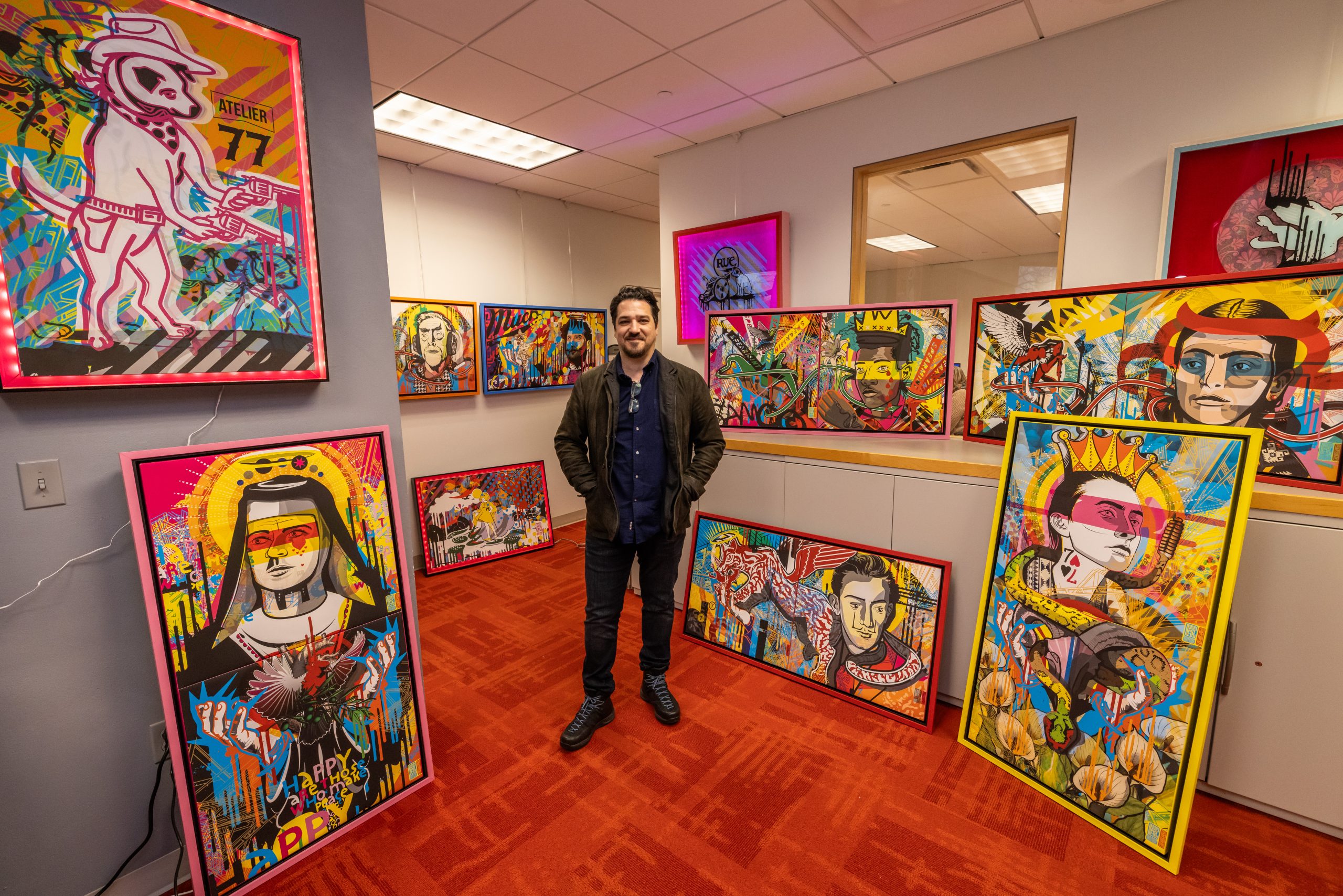
As a contemporary designer, artist and educator whose work spans digital and traditional media, Frank Corridori aims to create tension, raise questions and leave space for reinterpretation.
He’s not interested in providing answers through his art. He prefers sparking conversation.
Corridori is a professor of visual design in the Missouri School of Journalism, where he serves as creative director of MOJO Ad, the school’s student-staffed advertising agency. An exhibition of his artwork in the strategic communications offices of Walter Williams Hall brings that philosophy to life, inviting viewers to engage and draw their own conclusions.
Most of the 21 pieces on display come from a series of digital prints titled “After Your Heroes,” which sprang from asking his students to think about creative heroes.
“By the time I was in college, I had a list of artists and designers I admired,” he said. “I learned by emulating them.”
His series asks students to also identify heroes, dissect their work and ultimately find their own voices in the shadow of those influences. He deliberately avoids naming his inspirations outright in the wall labels, hoping his creative take on the hero will ignite students’ curiosity and independent exploration.
Another digital series, “Logo-A-GoGo,” stems from Corridori’s career in commercial design. Logos and brands are tools of persuasion and recognition, but in his hands, they are manipulated, recontextualized or stripped of their original intent. Reengineered, they become new avenues for original storytelling.
In class, Corridori walks students through creating multiple digital iterations, experimenting freely and then editing ruthlessly to distill the sharpest expression of an idea.
Corridori’s third series features traditional oil paintings of constellations. Though created by hand, the pieces follow a similar approach in analog form. He begins each work with detailed pencil studies on vellum, layering sheets to refine the composition. Once satisfied with the design, he transitions to painting on a wooden panel. The process is slow, methodical and meditative, yet it mirrors his digital workflow — grounded in iteration, reflection and careful editing.
It’s a lesson in patience as much as creativity, showing students that thoughtful work often takes time. For Corridori, motivation grows from action, but the hardest part can be getting started.
“I’m a perfectionist, but I try not to be too judgmental about the first steps of anything,” he said. “If you give yourself that grace, the process becomes less about getting it right and more about play — about exploration and enjoyment.”
NICOLE JOHNSTON
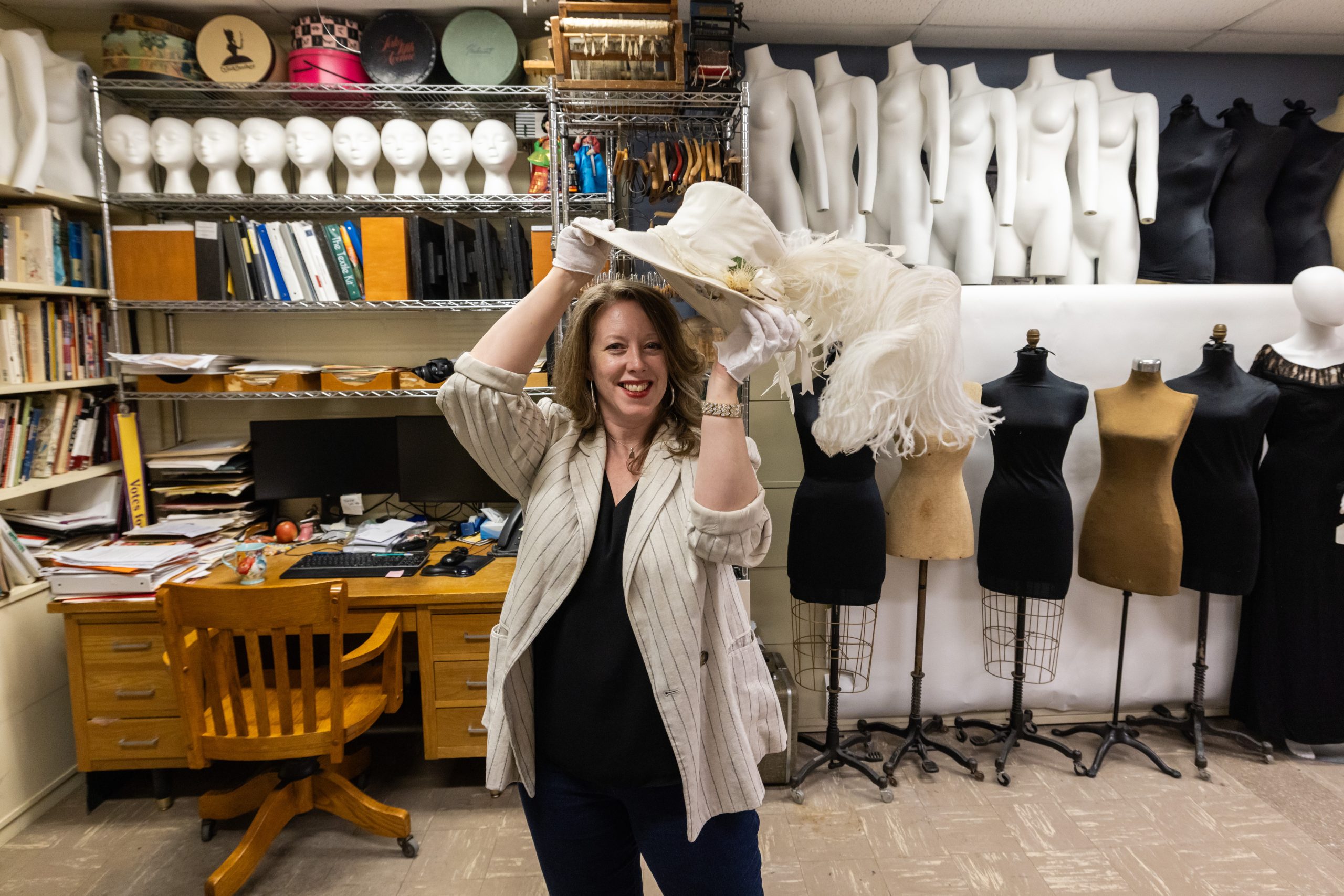
In Nicole Johnston’s office in Stanley Hall, mannequins and dress forms stand shoulder to shoulder, faceless sentinels of fashion posted across from bins overflowing with detached plastic arms and hands. Behind the uncanny assembly, racks of historic garments wait in quiet rows in a small adjoining room.
To a visitor, the scene might feel unsettling. To Johnston, BA ’97, MS ’11, it’s where her work takes shape.
As curator of the Missouri Historic Costume and Textile Collection and an instructor in dress history in the Department of Textile and Apparel Management in the College of Arts and Science, Johnston relies on mannequins and dress forms to not only display clothing but also help bring history to life.
That work is on full display in an exhibition at the State Historical Society of Missouri that commemorates the nation’s 250th anniversary through military uniforms, wartime posters and contemporary works, including 11 student designs.
But bringing those garments to life isn’t as simple as slipping them onto a form.
Many pieces in the historic costume collection, especially from the 1950s and earlier, were made for bodies much smaller than today’s standard forms. The mannequins, most of which are a size 6, can’t be adjusted. That leaves Johnston and her students improvising, often turning to dress forms that can be downsized to fit delicate historic pieces.
Even then, the process can be a struggle.
Dressing the mannequins, Johnston said, is “like dressing a toddler.” Their rigid limbs don’t bend, forcing handlers to maneuver multilayered uniforms — shirts, vests and jackets — over unyielding arms.
The collection itself reflects both resourcefulness and generosity. In 2023, the Missouri History Museum donated 18 mannequins, dramatically expanding what Johnston and her students could do.
Mannequins, she said, can transform a garment. On a dress form, clothing can look flat, almost abstract. On a mannequin, it takes on a body and a presence. The silhouette sharpens, and the history of the clothing surfaces.
In Johnston’s office, surrounded by silent figures waiting to be dressed, that transformation is always in progress. Each mannequin is a challenge, a tool and ultimately, a conduit that Johnston and her students use to tell the story of the clothes it wears.
SPEER MORGAN and KRIS SOMERVILLE
On the far west side of the fourth floor of McReynolds Hall, a low hum of conversation rises above clacking keys and rustling paper. Around a table, University of Missouri students, staff and faculty debate the merits of a short story submitted from halfway across the world.
In this unassuming cluster of offices, those conversations carry weight — they can shape a writer’s first publication and introduce a new voice to the literary world.
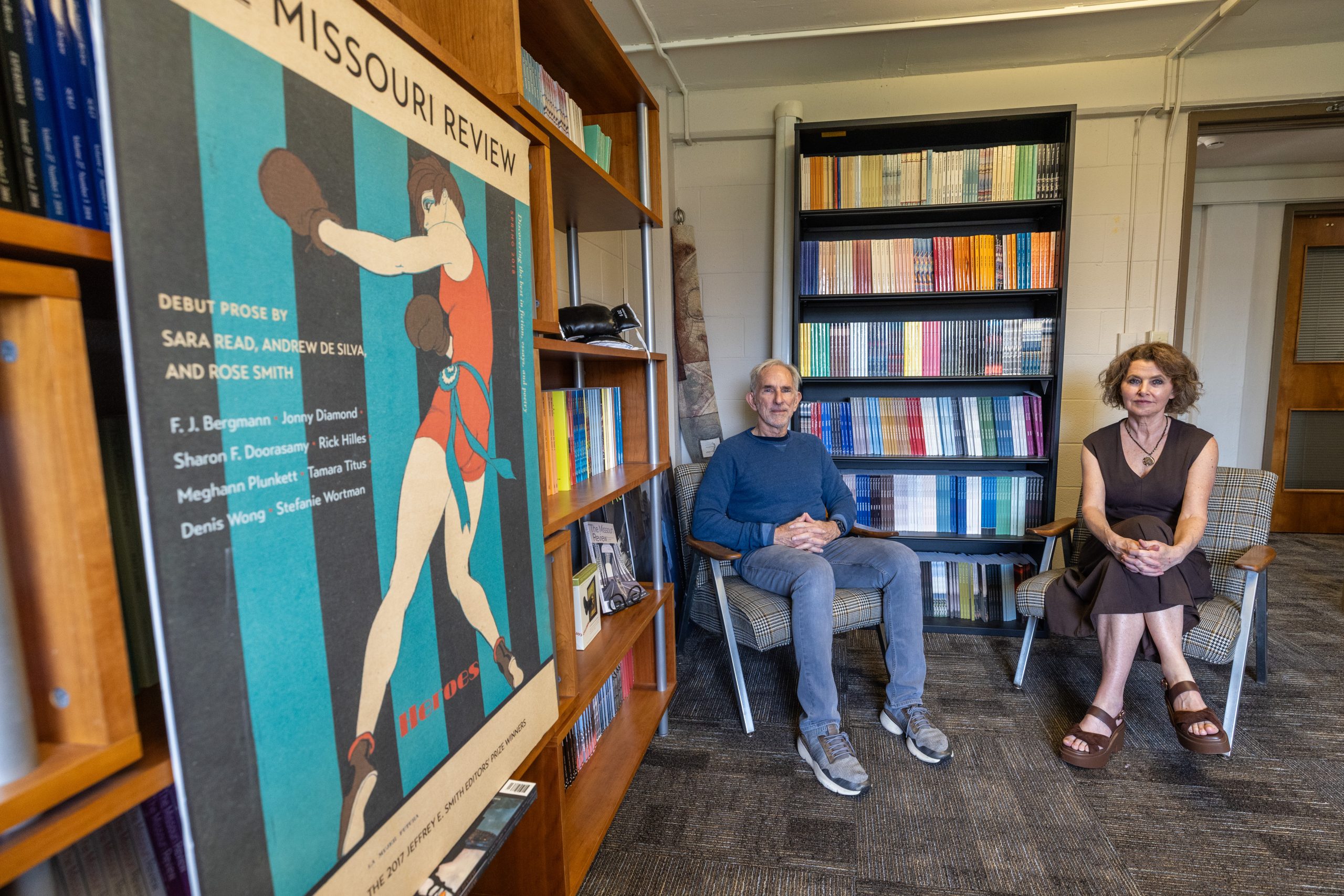
This is The Missouri Review, one of the most respected literary magazines in the United States and a part of the College of Arts and Science. Founded in 1978 at Mizzou, the quarterly journal has built a reputation for discovering new voices in fiction, nonfiction and poetry, often before the rest of the publishing world takes notice.
Its pages and online exclusives have introduced writers who go on to win major honors, from the Pulitzer Prize to the National Book Award, though its mission of shaping the contemporary literary scene with works by new writers has remained unchanged.
Tucked among the offices is a reading room, its shelves lined with back issues that invite visitors to linger over a literary collection. Here, one might stumble upon the magazine’s popular “Found Text” series, featuring previously unpublished work by iconic writers such as Charlotte Brontë, William Faulkner and Mark Twain, or pause to study distinctive covers, book reviews and interviews. Only three first-edition copies remain in the office, a quiet reminder of the magazine’s history.
Sustaining a literary magazine for five decades is no small feat.
“In many ways, it’s like running a small business,” Kris Somerville, MA ’02, marketing coordinator, said. “You have to be resourceful, adaptable and entrepreneurial to keep it alive.”
Editor Speer Morgan has been with the magazine since its earliest days, when literary magazines nationwide were experiencing renewal. Back then, The Missouri Review was carving out its identity through ambition and improvisation. By the mid-1980s, Morgan and his staff made a decision: If they were going to continue, they would aim to create the best literary magazine in the country.
They built connections, refined their editorial vision and earned national recognition.
“There was an Esquire article in the late 1990s that listed The Missouri Review as one of the best publishers in the country,” Morgan said.
For more than 30 years, student interns have played a pivotal role in the magazine’s success. Along with staff, they read thousands of submissions. The process is immersive, and interns quickly learn what works, what doesn’t and why.
“The goal for them as an intern is to be the first read of a piece that gets published in the magazine,” Somerville said.
Despite the enormous influx of submissions, Morgan said the magazine strives to treat everyone equally. The staff reads year-round.
“And we respond promptly, which is unique for literary journals,” Somerville said. “We’re known to be among the friendliest because we write personal responses. We aren’t diagnosing a manuscript, but we’re encouraging writers and letting them know it was read and what we admired about it.”
As it approaches its 50th anniversary, The Missouri Review stands as both a training ground and a launching pad — a place where emerging editors and writers find their footing.
KELLY WARZINIK
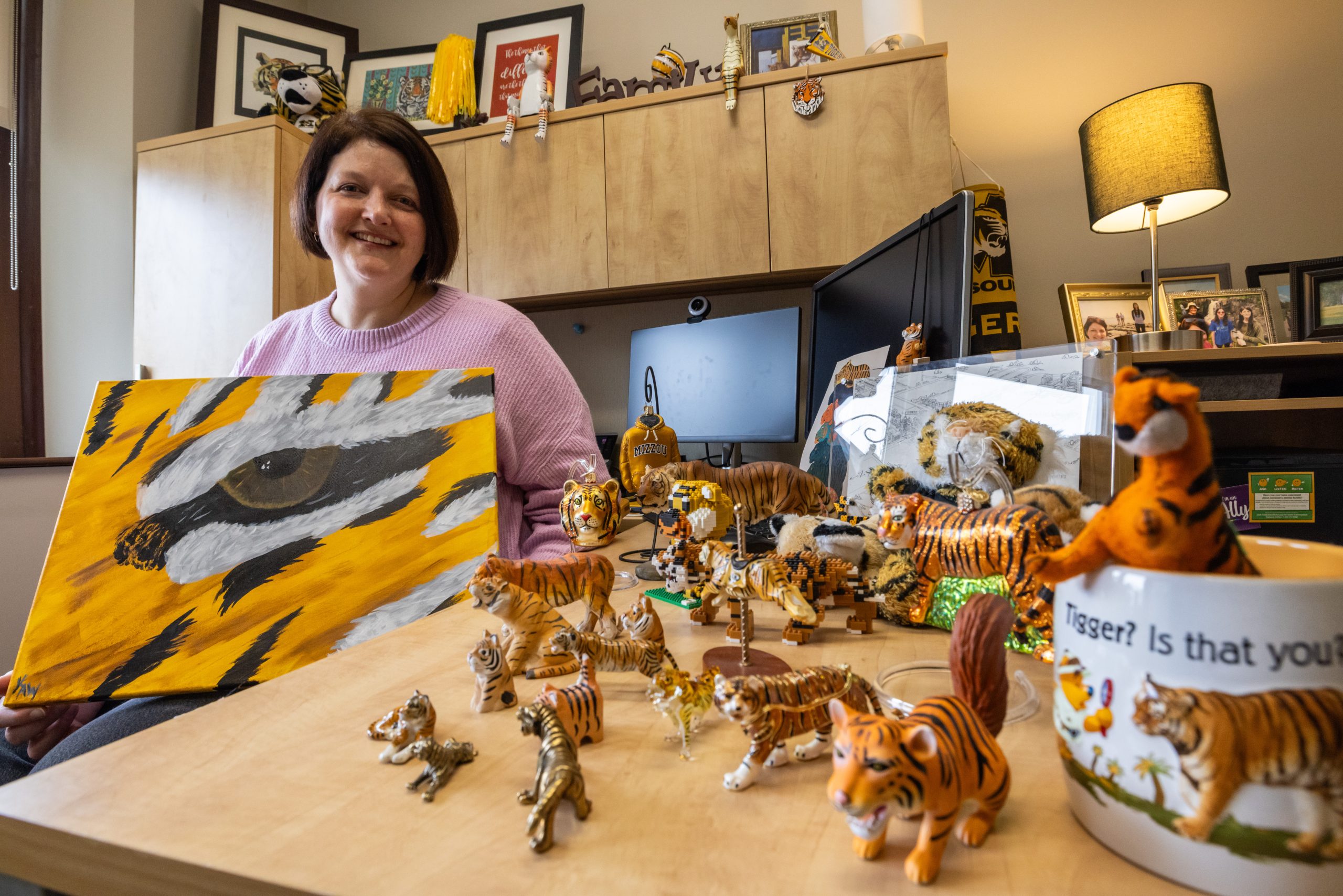
Kelly Warzinik, BS ’97, MS ’00, keeps two things close at hand in her office in the College of Education and Human Development: a map of campus and a growing collection of tigers.
Printed in 1958, the map shows a campus still unfinished, the Memorial Student Union with only its north wing standing. It was given to her father, Eldon Cole, before he became the longest-serving faculty member in university history, logging 58 years with MU Extension.
Warzinik didn’t know the map existed until 2020, when her family sorted through boxes at her aunt’s house and found it among old papers, report cards and other fragments of a life story.
She asked her father to sign it, almost as a joke.
Now displayed in a glass frame in her office, the map bears his name and marks not just a place, but the beginning of her family’s Mizzou legacy. Cole continued his work until just two days before his death in 2022 at age 81.
“He was my idol,” she said.
Across the room, an assortment of ornamental tigers tells a different version of the family’s Mizzou story.
The collection started small with a single figurine, a Christmas gift from a supervisor when Warzinik was a student working in Ellis Library. For years, it stood alone. Then, gradually, others joined: a painted canvas from a colleague outing, a figurine picked up here or there, two LEGO tigers built by her daughters.
Now, she adds one each semester.
Some are playful, such as a tiger with a squirrel’s tail, a nod to the campus squirrels she’s grown to love. Others are simple, classic, unmistakably Mizzou. Together, they’ve transformed her office into a quiet celebration of a place that has shaped nearly every part of her life.
For Warzinik, Mizzou was never just a college.
It’s where her parents met and the reason she grew up on the sidelines of cattle calls and farm visits across the state, riding along to livestock shows, watching her dad roll down the window to call out to cattle in passing fields.
Today, as an instructor and advisor in the Department of Human Development and Family Science, she carries lessons she learned from him forward in ways that feel familiar: answering student emails late at night, taking the extra call, making time when it matters.
Now, with one daughter at Mizzou and another not far behind, Warzinik sees the story unfolding again in a family deeply rooted in a place that continues to shape who they are.
The map shows where it started. The tigers show it never really ends.
ANGIE ZAPATA
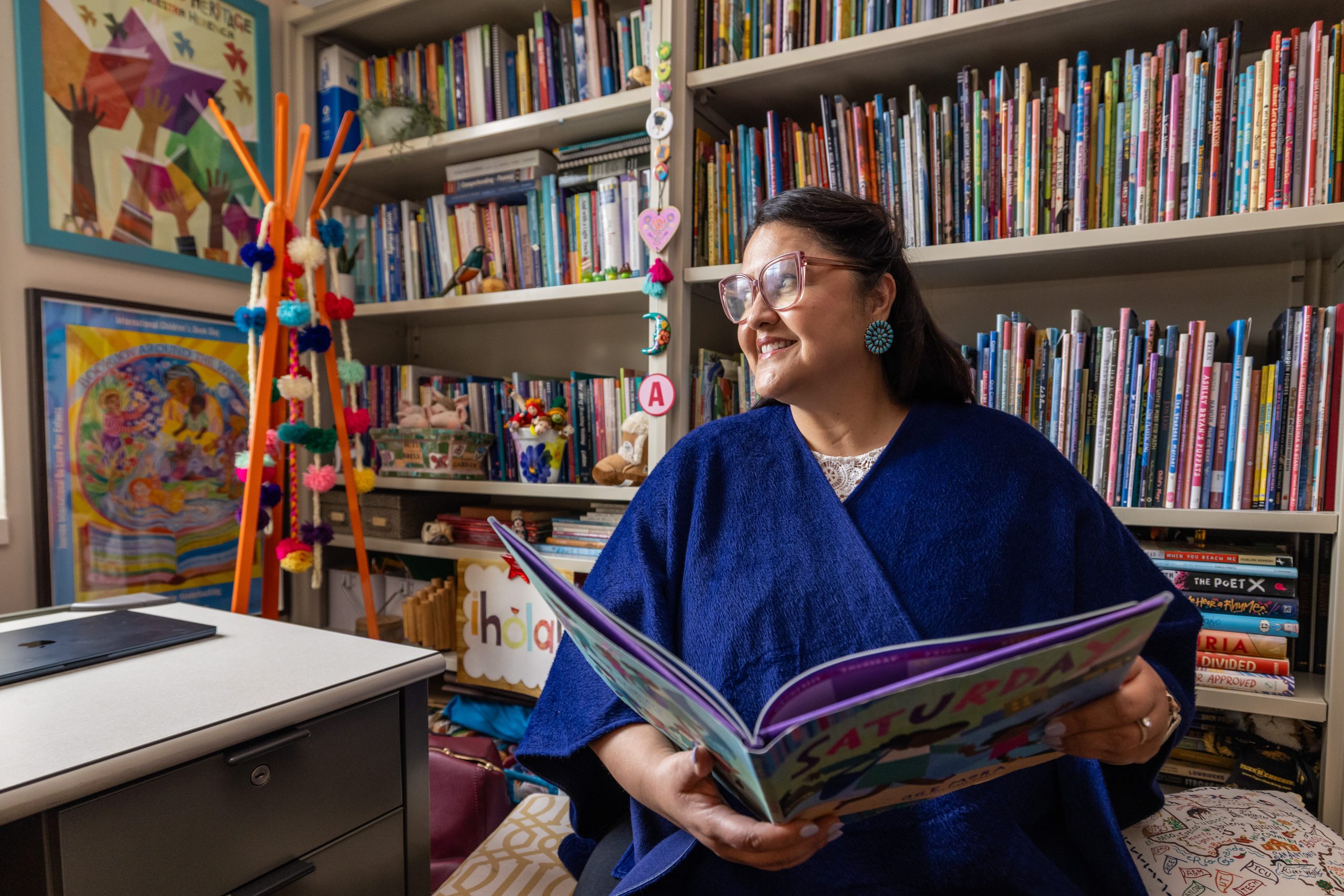
The first thing you notice in Angie Zapata’s Townsend Hall office isn’t her desk, it’s the books.
About 750 children’s picture books line the shelves, with hundreds more stacked in her home library. She began building the collection in 1997, when she started teaching and quickly saw how stories connect readers through shared experiences while opening doors to new worlds.
“Story is a pathway to teach language and literacy,” Zapata, an associate professor of language and literacies education in the College of Education and Human Development, said. “But it’s also a way for people to feel seen and heard, to recognize their own lives in a text while also encountering worlds different from their own.”
For her, picture books are more than teaching tools, they are entry points to both discovery and belonging.
That philosophy shapes how she shares her collection. The books aren’t tucked away or reserved for display. They are meant to be handled, explored and borrowed. Zapata keeps them accessible to Mizzou students and colleagues, hoping each visitor leaves with both a sense of recognition and a spark of discovery.
A longtime educator and researcher, Zapata has earned national recognition for her contributions to the field. Her collection reflects that breadth, spanning genres such as poetry, biography and fiction.
Her small office plays a role in keeping the collection dynamic.
“If I had a bigger space, I’d fill it,” she said. “This smaller space forces me to keep the collection fresh.”
Some of her favorite moments come from watching others reconnect with stories.
“I love when colleagues rediscover an old favorite and say, ‘Oh my gosh, I remember this one!’ or find something new and ask, ‘Tell me about this one,’” she said.
For Zapata, the simplicity of picture books is deceptive. Picture books demand a unique kind of reading, one that asks readers to interpret both words and images, and to make meaning in the space between them.
“You can read the pictures, or you can read the text,” she said. “The real work is bringing the two together.”
Amid academic deadlines and research demands, Zapata’s collection serves as a reminder of the field’s importance.
“This work is serious,” she said. “But it can also be incredibly joyful and intellectually creative. Stories help us reconnect to that.”
STEVE BORGELT
As the College of Engineering’s unofficial historian, Steve Borgelt, BS ’79, MS ’82, isn’t just collecting mementos — he’s safeguarding a legacy.
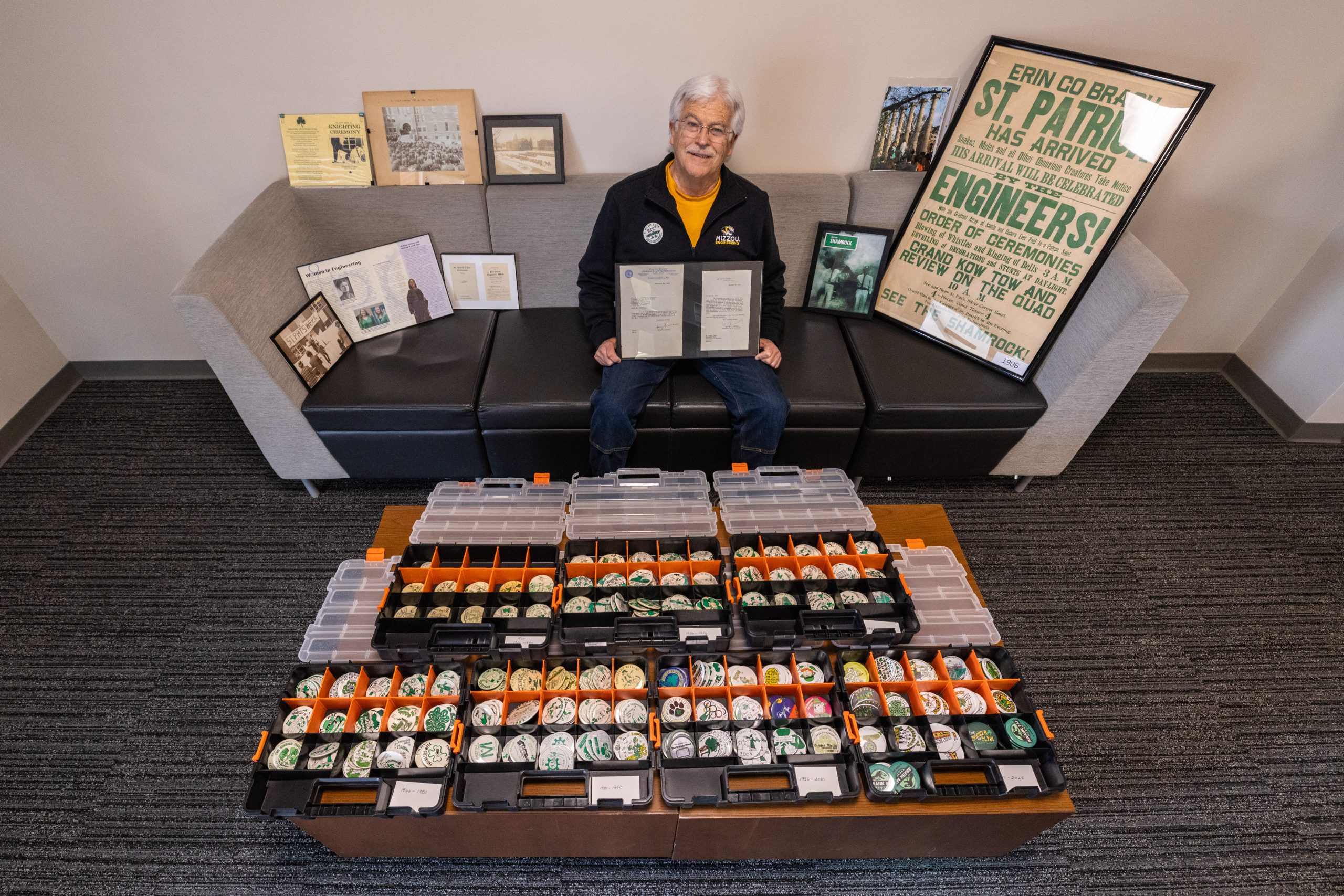
Organized chronologically in tackle box–like plastic containers, a collection of small, round buttons traces more than a century of Mizzou Engineering history. Some are metal, others cardboard, many worn with age.
Borgelt, associate professor emeritus of chemical and biomedical engineering, has carefully preserved nearly every Engineers Week button from 1920 to today.
Borgelt, who joined the Mizzou faculty in 1989, has long been known for his organizational skills and dedication to students. Over the years, he’s earned numerous teaching and advising awards.
Now, even in semi-retirement, he remains deeply involved as an advisor and accreditation coordinator.
The history of the buttons is tied to Borgelt’s favorite Mizzou engineering story, which began on a warm March day in 1903 when a group of engineering students skipped class because of the unseasonably nice weather. To announce the cut, they posted signs around the engineering building claiming that St. Patrick was an engineer and therefore deserved a holiday.
University President Richard Henry Jesse was less amused, ordering the students back to class. Nevertheless, the tradition continued. By 1905, the first St. Patrick’s Day parade was held at Mizzou. Soon, there were knighting ceremonies, the kissing of the Blarney Stone and a growing list of rituals that evolved into what is now Engineers Week.
“People will tell me, ‘St. Patrick wasn’t an engineer,’” Borgelt said. “And I say, ‘I know. But it creates community.’”
That’s what keeps Borgelt invested. As an advisor to several student organizations, he has watched generations of students take ownership of the weeklong celebration, planning events, raising funds and leading the process.
Today, Mizzou’s Engineers Week is one of the most recognized in the country, earning national honors in recent years.
For Borgelt, the buttons, the stories and the rituals aren’t just relics. They keep Mizzou engineering history alive.