April 15, 2026
Contact: Sara Diedrich, diedrichs@missouri.edu
Still undecided about what area of medicine she wanted to explore at the University of Missouri, freshman Chynna Gardner thought she understood what a career in nursing might be like — until she landed a work-study job behind the scenes at the Miller Family Simulation Center in the Sinclair School of Nursing, helping keep the facility clean and running smoothly.
Here, Gardner watched students do more than study nursing. She saw them experiencing their future careers through hands-on skills such as blood draws, tracheostomy care and CPR in a realistic hospital setting. The St. Louis native found the energy of the center and the level of instruction so electrifying that she decided nursing was the path she wanted to follow at Mizzou.
"It’s been such a valuable experience to see up close what’s required to be a nurse," she said. "I really love this job."
It’s National Student Employment Week, and Gardner is among more than 6,000 student employees at Mizzou who contribute their talents to offices, labs and programs across campus.
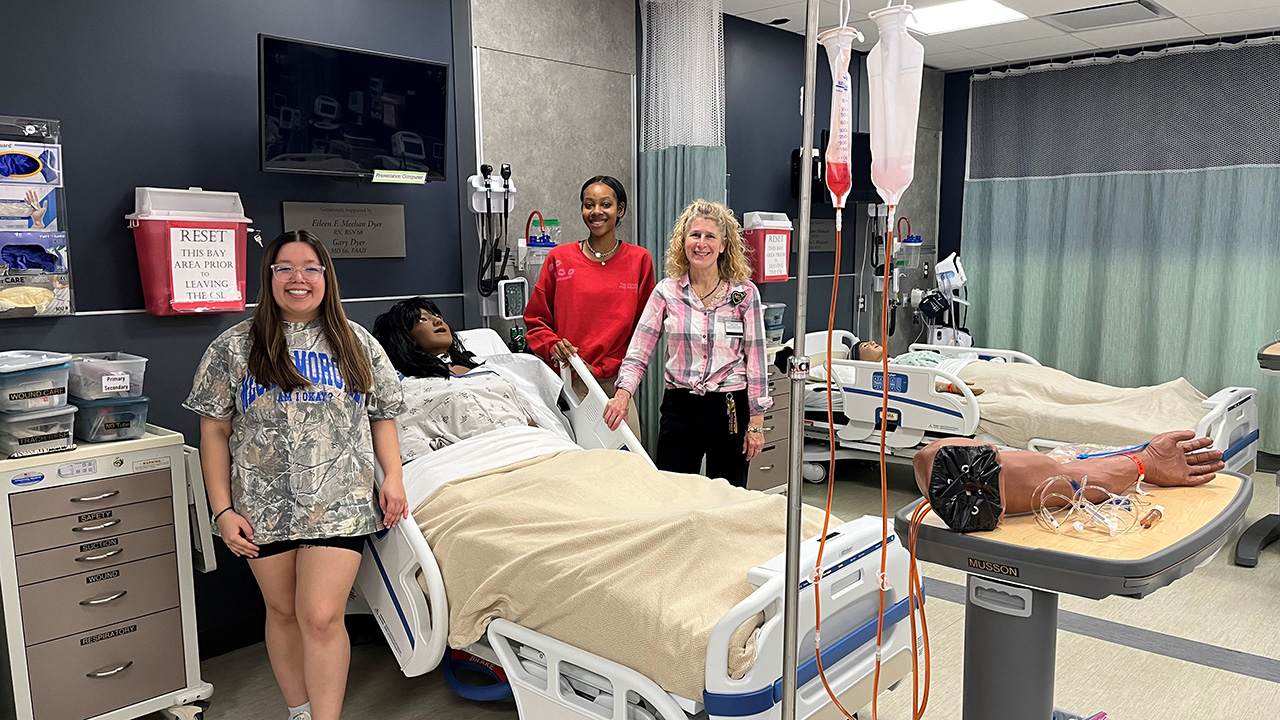
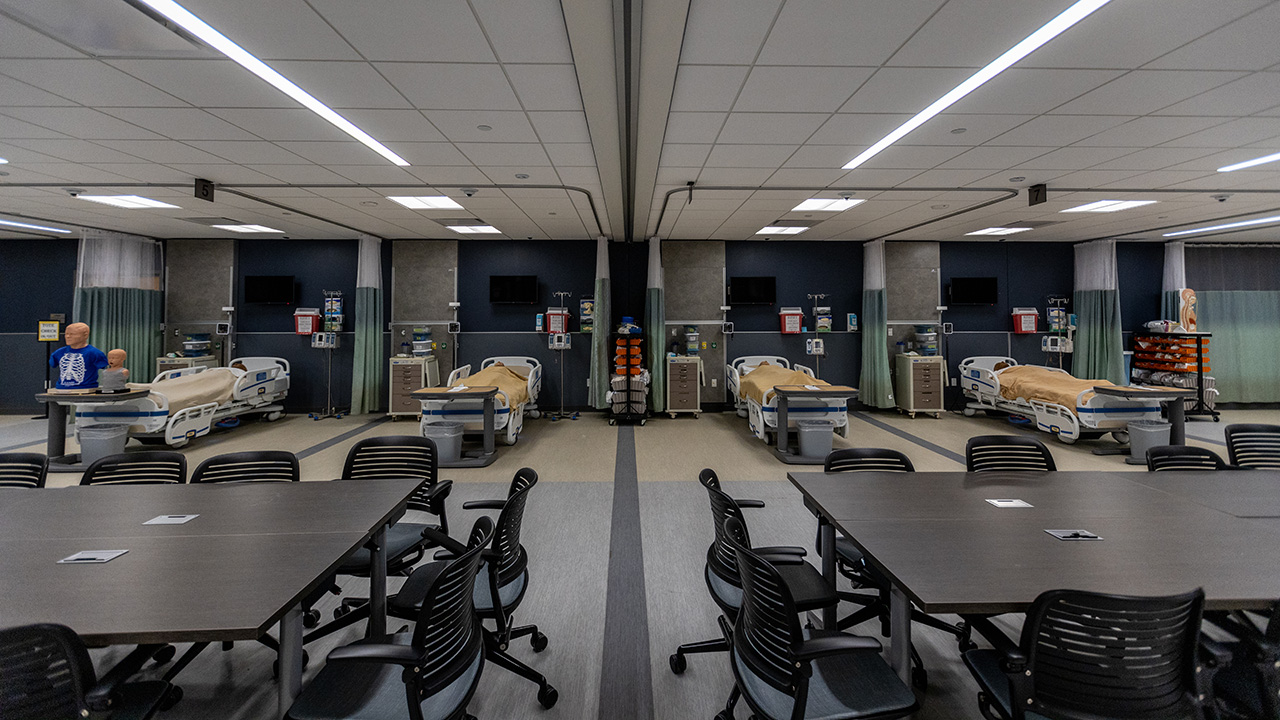
At the School of Nursing, Gardner is one of six work-study students who help keep the simulation center clean, organized and fully stocked. That’s no small task. The center includes two instructional spaces: the Clinical Skills Lab, equipped with 14 hospital-style rooms divided by curtains and stocked with adjustable beds, vital sign machines and supply stations; and the Hi-Fidelity Simulation Suite, designed to replicate a seven-bed Intensive Care Unit where nursing students train in lifelike scenarios that prepare them for critical patient care and life-saving techniques.
The environment is so lifelike that visitors might forget it’s a simulation lab if not for the manikin patients and the classroom hub where instructors bring lessons to life.
Keeping the center running
Work-study students play an invaluable role in keeping the facility sanitized and operating at its best, Jeni Ragsdell, simulation program/project coordinator, said. The center is open for instruction during the workday and remains available until 7 p.m. for students to practice their skills.
“The work-study students serve as our eyes and ears, making sure equipment is properly used, returned and accounted for,” Ragsdell said. “They handle cleanup, reset simulation spaces and manage laundry. They are constantly keeping things in order.”
Work-study students follow a daily checklist to keep the simulation center running smoothly, along with task-specific lists tailored to each day’s needs. For example, if 120 students are scheduled to practice IV insertions and catheter care, the work-study students receive a detailed set of responsibilities to prepare the space, such as stripping beds, restocking supplies and doing laundry. They also create artificial blood by combining distilled water with a powdered mixture.
The role requires flexibility, as no two days are the same, and gives students valuable hands-on experience. With hundreds of current and prospective students and visitors moving through the center each week, the space must always be guest-ready.
“We expect a consistent, professional appearance after each training session,” Ragsdell said. “Evening shifts are particularly busy, so I typically schedule two or three work-study students to keep up with the demand.”
Building skills and gaining confidence
Brittni Chin, a junior nursing student from Carbondale, Illinois, has worked in the simulation center since her freshman year. She arrived at Mizzou as a certified nurse assistant, confident in her career path, but her experience in the center has still been eye-opening.
“Over time, the experience has been incredibly valuable for nursing school,” she said. “I’ve been able to observe a wide range of skills in action and become familiar with the equipment required for each one. That hands-on exposure has helped me better understand the material and explain it more confidently on exams.”
Working in the simulation center has also helped Chin build stronger relationships with fellow nursing students and instructors.
“I’m much more comfortable around the professors and not afraid to ask questions or seek help,” Chin said. “Since I usually work during the day, I see faculty often and sometimes assist with setting up for classes by gathering materials and preparing what they need.”
For Gardner, the work-study experience has fueled her hands-on approach to learning and reinforced her decision to become a nurse.
Their work makes training possible
The simulation center is where future lifesavers are made.
“Here, nursing students practice again and again, building the muscle memory and confidence they need before stepping into a real hospital,” Ragsdell said. “By the time they’re on the hospital floor, they’re professionally sharp and emotionally prepared. They’re ready, and it’s nothing short of impressive.”
And behind the scenes, Garner, Chin and fellow work-study students provide the fuel that keeps everything running flawlessly.
“Their support makes this high-impact training possible,” Ragsdell said. “We couldn’t do it without them.”