Nov. 4, 2026
Contact: Sara Diedrich, diedrichs@missouri.edu
Photo by Abbie Lankitus
University of Missouri business students are putting their classroom skills to work on a high-stakes assignment: helping one of the nation's leading research reactors explore new opportunities to deliver lifesaving cancer treatments to patients around the world.
The University of Missouri Research Reactor (MURR) is the nation’s most powerful of its kind, operating around the clock to produce medical radioisotopes. It is the only U.S. producer of four medical radioisotopes used by researchers, health care providers and radiopharmaceutical companies worldwide.
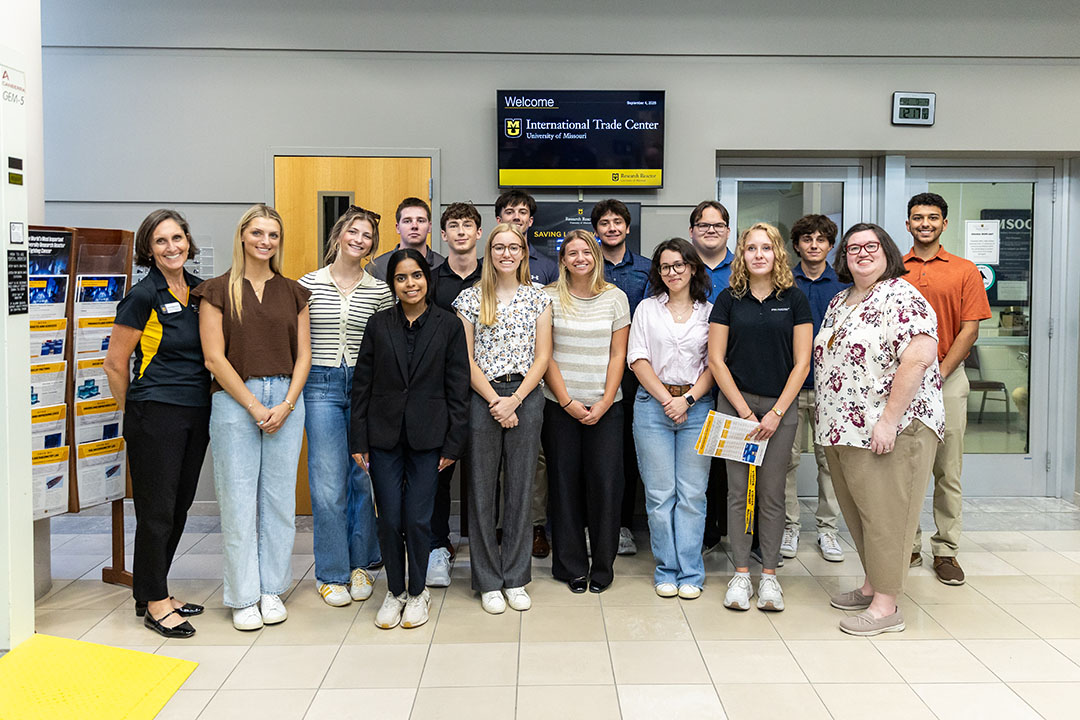
Through a new collaboration between MURR and the Robert J. Trulaske, Sr. College of Business, student interns with the International Trade Center (ITC) are conducting research to support MURR’s international growth while gaining firsthand experience with a world-class scientific operation.
“This project gives students hands-on experience researching cutting-edge technologies, innovative treatments and an emerging industry,” said Jackie Rasmussen, assistant teaching professor of management and director of the ITC. “They’re applying what they learn in the classroom to a real-world project with a Mizzou partner.”
Each semester, the ITC pairs 16 undergraduate student interns with four organizations seeking to expand their international sales. Students conduct market research and analyze data to help their clients evaluate opportunities abroad.
For the MURR project, the students began with a tour of the facility and a meeting with its business development team. They then analyzed global trade data, industry trends, economic indicators and market conditions to identify 25 to 30 promising markets. After presenting their initial findings to the MURR team, they narrowed the list to six markets for further study.
Their findings will give MURR’s business development team additional insights into potential customers and partners in those markets.
The collaboration is also introducing students to career possibilities they might not have considered.
While nuclear research facilities are known for their scientific work, they also depend on professionals with expertise in business development, finance and international trade. As the nuclear workforce expands, so will the demand for professionals who can support the industry.
For Zach Brazel, a junior majoring in economics and in business administration with an emphasis in finance, the project has shown how business skills apply to different industries.
“This project connects business education with scientific research and global health care, allowing us to see how our skills can work across disciplines,” he said. “That connection makes the experience especially valuable as I prepare to begin my career.”
Ellie Duncan, a senior majoring in business administration with an emphasis in finance and banking, appreciates knowing her work could make a difference beyond the classroom.
“It feels really rewarding, and it definitely gives you a sense of responsibility,” Duncan said.