Oct. 7, 2026
Contact: Brian Consiglio, consigliob@missouri.edu
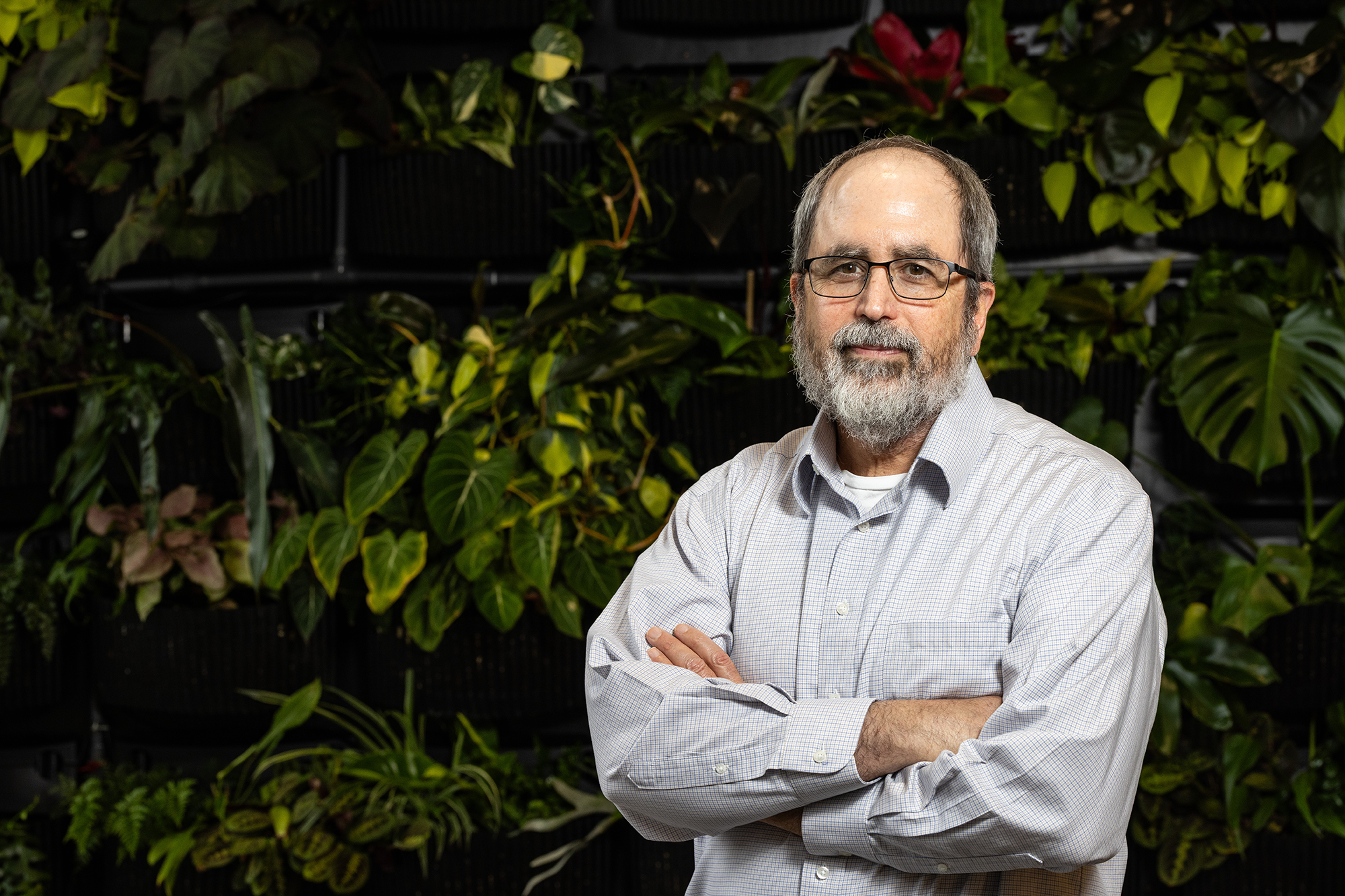
Photo by Abbie Lankitus
At the University of Missouri, plant scientist Ron Mittler is rewriting the playbook for how scientists study life by asking what happens when living organisms face multiple stresses at once.
For decades, scientists have studied stress by isolating individual factors — exposing a plant to drought, for example, while controlling everything else. That approach has helped researchers understand how organisms respond to specific challenges in a controlled laboratory environment.
But nature is rarely that simple.
A plant growing in a Missouri field might face drought, heat and intense sunlight simultaneously. It could later encounter flooding, salty soil and pollutants. Those stressors can occur at different intensities, for different lengths of time and in different combinations.
Earlier this year, Mittler demonstrated that principle by exposing a model plant simultaneously to excessive heat, sunlight and salty soil. Its survival depended on a protein called bHLH35. Plants lacking the protein died under the three-stressor combination, while plants with additional bHLH35 remained healthier.
The surprising part? That protein does not play the same life-saving role when the plant encounters each of these three stressors individually. It becomes critical only when heat, sunlight and salty soil strike at once.
That’s why, in a commentary published in Nature Reviews Molecular Cell Biology, Mittler and his team are calling on researchers to better reflect the complexity of the real world in their experiments.
“If one protein responds to a certain stressor, let’s say intense heat, and another protein responds to a different stressor, let’s say intense sunlight, you might think both proteins get activated if those two stressors hit the plant at the same time,” Mittler, a Curators’ Distinguished Professor in the College of Agriculture, Food and Natural Resources, said. “But we are learning the combination of stressors simultaneously can trigger a specific biological response that does not occur with either stress alone. In other words, the biological response to A+B can be fundamentally different from the responses to A and B individually.”
The idea could eventually have implications far beyond growing more resilient plants.
Understanding how multiple stressors interact could help scientists better study animals or ecosystems that are exposed to combinations of pollution, pesticides, microplastics, weather-related stressors and other environmental changes. This could eventually inform strategies to help protect biodiversity or reduce habitat loss.
Mittler sees potential applications in human medicine, too. Researchers already use combinations of drugs to treat some infections and cancers. Better understanding of how different combinations affect cells at the molecular level could eventually help scientists design more effective treatments while limiting harmful side effects.
“Our lab’s previous research has shown that once an organism gets hit with four or five stressors simultaneously, the health of the organism starts to deteriorate dramatically,” Mittler said. “Perhaps we can use that knowledge to our advantage when it comes to treating cancer or bacterial infections. If a combination of two or three drugs is not proving to be effective, perhaps a combination of four or five drugs given at extremely small doses can be more effective without causing side effects or harm to healthy cells.”
While the concept sounds simple, studying multiple stressors is time-consuming and expensive. Adding another stressor to an experiment multiplies the number of conditions researchers must analyze. Adding different intensities, durations and sequences makes the experiment even more complicated, but Mittler argues it is worth it because the conditions more closely mimic real-world environments.
He is hopeful that advances in artificial intelligence and other analytical tools will help researchers make sense of the resulting mountains of data more efficiently than ever before.
“I’ve been raising awareness about this topic for years, whether it’s through publishing papers, giving presentations at conferences or on social media,” Mittler said. “More researchers around the world are starting to take notice, and we are hopeful our momentum continues going forward.”
At Mizzou, Mittler said collaborations with scientists outside his own discipline, particularly in the Bond Life Sciences Center, have helped shape how he thinks about the problem.
“The opportunities I’ve had to work with field scientists at Mizzou have allowed me to study crops in the environments where they actually grow,” Mittler said. “That perspective I’ve gained out in the field has revealed insights that were maybe invisible to me in the lab as a plant biologist, which ultimately helps us better understand the complexity organisms encounter in the real world.”
“A call for studying the impact of multiple stressors on biological systems” was published in Nature Reviews Molecular Cell Biology.