Contact: Sara Diedrich, diedrichs@missouri.edu
Dec. 15, 2025
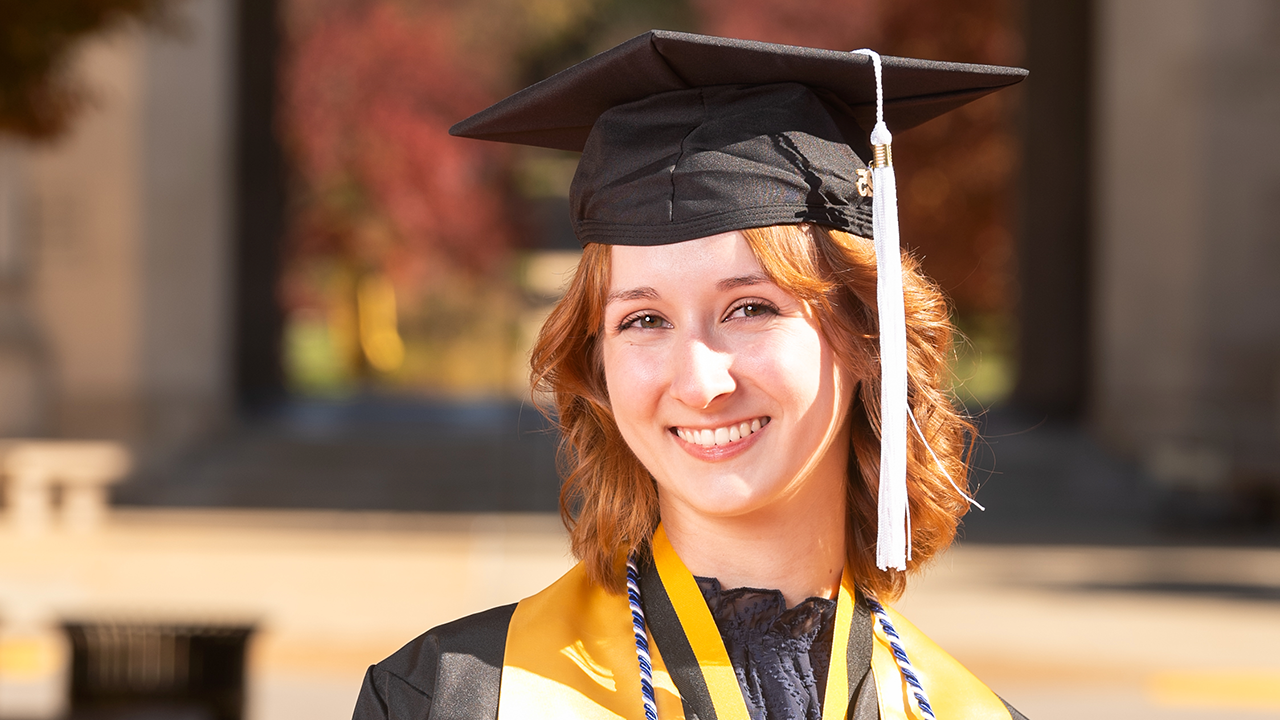
Photo courtesy of Jessica Schroeder
Jessica Schroeder has always had a knack for numbers. But she never realized just how exciting math could be until a sophomore-year geology class at the University of Missouri revealed an unexpected passion: studying earthquakes.
The discovery shook her world.
On Friday, Schroeder will graduate with a degree in mathematics from Mizzou’s College of Arts and Science and an Honors Certificate from the Honors College, ready to pursue an advanced degree in geophysics and dig even deeper into the science of seismic activity.
“In the beginning, I wasn’t sure what I wanted to study, but I knew Mizzou had so many options,” Schroeder, who grew up in Columbia, Missouri, said. “I figured I could dip my toe into anything I wanted.”
Studying earthquakes is math
Schroeder was in middle school when she first realized math was a subject that came easier to her than to most of her classmates. By her freshman year of high school, she was tutoring local children, eager to spark the same enthusiasm for numbers in others.
At Mizzou, Schroeder embraced her passion for math, even as she explored how it might shape her future career.
“My dad encouraged me to pursue the degree, but I think the biggest motivator to majoring in math was my love of solving problems and expanding my ability to help others with math,” she said.
Schroeder discovered a whole new way to apply her skills in an introductory geology course, where Eric Sandvol, professor emeritus of geological sciences, showed her how math could be used to study the magnitude of earthquakes. It was a lightbulb moment for Schroeder, who realized she could pursue a career studying earthquakes.
“I really like the math involved in studying earthquakes,” she said. “To me, the equations feel like a giant jigsaw puzzle — you’re constantly figuring out how the pieces fit together. I love the idea of taking real-world problems like earthquakes and using my math skills to help people in a tangible way.”
With Sandvol’s guidance, Schroeder secured a National Science Foundation Research Experience for Undergraduates internship last summer at Harvard University, where she studied earthquakes in Japan under a renowned seismologist. She will fly to New Orleans this month to present her work at the American Geophysical Union Annual Meeting.
“The purpose of the project is to compare earthquakes in Japan’s Tohoku region to determine if there’s a notable difference between the characteristics of earthquakes that generate tsunamis and those that don’t,” Schroeder said. “Our hope is that my work can eventually be built upon to improve tsunami warning systems for at-risk communities.”
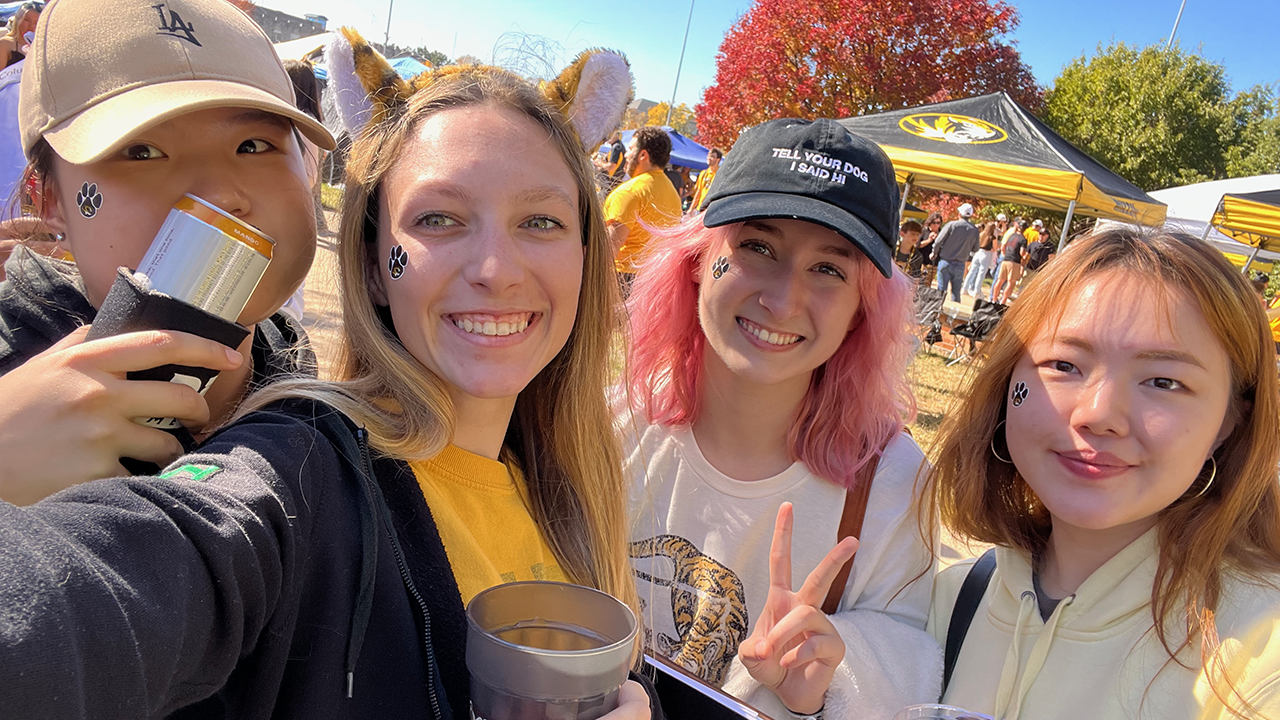
Schroeder, third from the left, with friends at a Tiger football game.
Beyond the right answer
Sandvol not only introduced Schroeder to a new way of using math, but he also challenged her academically, a push that made Schroeder a stronger, more insightful student.
“I’m the type of student who always wants to give the right answer,” she said. “But he pushed me to think beyond correctness and consider why an answer was right. A lot of the time, I didn’t get it right, and that taught me humility, which was good for me.”
He also broadened her perspective, reminding Schroeder that knowledge is limitless and that a math degree can unlock opportunities well beyond the classroom.
Last year, Mizzou’s Honors College recognized Schroeder’s outstanding academic work with the Hayden Scholarship. Eager to explore her math acumen, she also took part in the Department of Mathematics’ Directed Reading Program (DRP), which paired her with a graduate student for a semester-long project. Her project examined how a three-dimensional plate vibrates, the mathematics governing those motions and how to model them using computer simulations.
“The experience strengthened the foundational skills I need for earthquake research and sharpened my coding abilities,” she said.
Friendships far and near
Outside of academics, Schroeder also sought out new ways to build friendships at Mizzou.
Fascinated by Asian culture — an interest she had cultivated by teaching herself Korean in high school — she found a home at the International Programs’ Asian Affairs Center. There, she took a leadership role in the Collegiate Ambassador Program, guiding visiting students as a mentor, tour guide and friend. Many of those students became close friends who even spent holidays with her family.
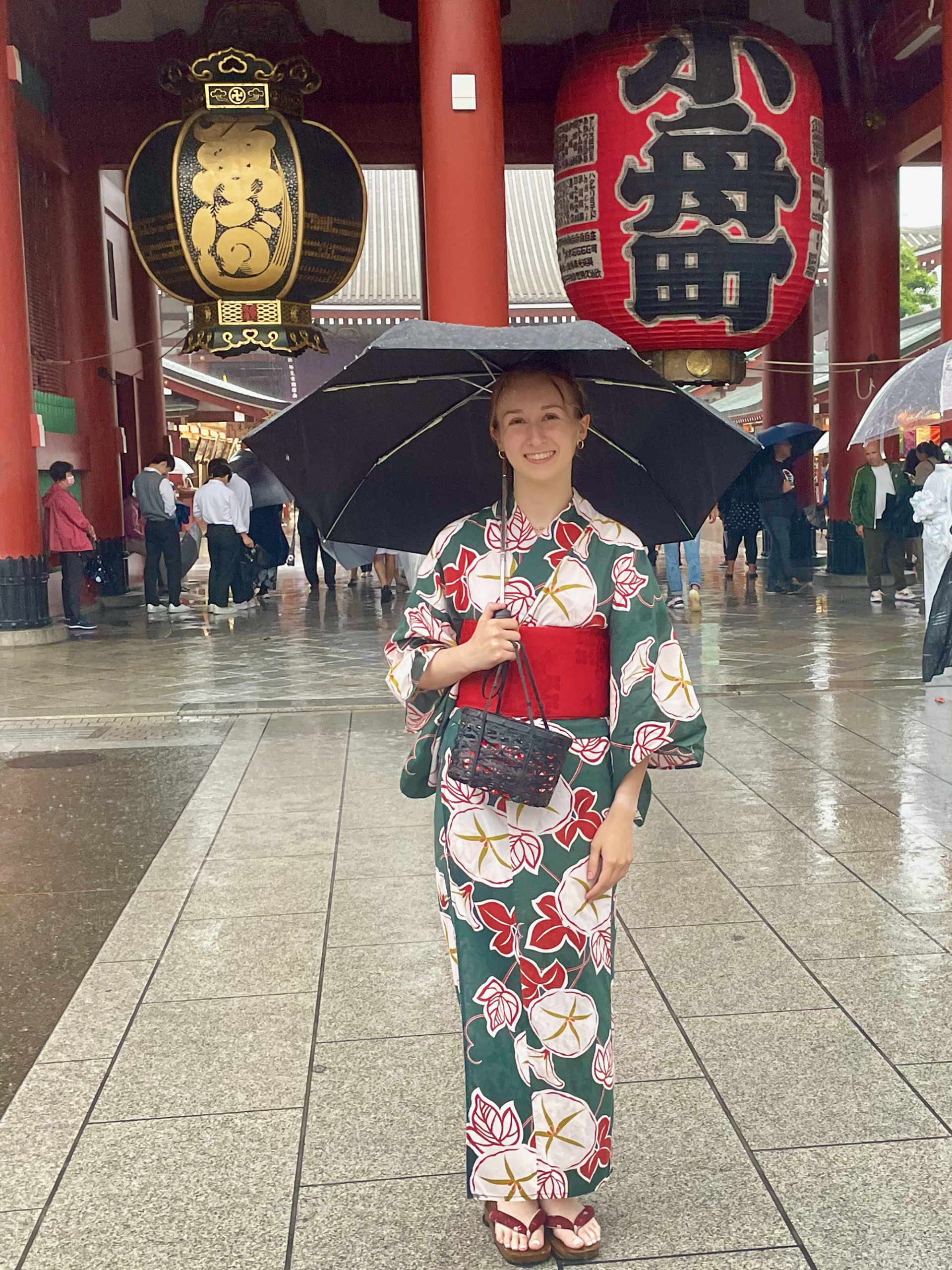
The summer after her junior year, Schroeder embarked on a study abroad adventure, spending two weeks in Japan and four weeks in Korea. Along the way, she reconnected with some of her Mizzou friends, creating some of her most cherished college memories.
“They went out of their way to show me around the cities and share as much of the local culture as possible,” she said. “In Korea, my friends spent an entire weekend with me in Seoul and surprised me with a cake and gifts. Seeing that our friendship extended far beyond the university was amazing. It was my first time leaving Columbia on my own, and being half a world away from my family was really hard. But my friends made me feel so comfortable and at home during my trip.”
Joy of discovery
When Schroeder first arrived at Mizzou, she was laser-focused on academics and graduating early, if possible. But as she built friendships and uncovered new academic passions, that urgency faded. She found herself slowing down, not out of necessity, but out of a genuine joy for learning and being in the moment.
“I often think about that geology class, a course that had nothing to do with math yet ended up changing the entire direction of my future,” she said. “All because I took a class about rocks.”
Ultimately, Schroeder hopes to teach and conduct research at a major university such as Mizzou. After all, it was here that she found the support to take calculated risks that opened doors she might otherwise have missed — experiences that strengthened her both as a student and as a person.
Her advice to incoming freshmen is simple: Ask the question. Start the conversation. Go after the opportunity that feels too big.
“Shoot your shot,” Schroeder said. “By that I mean, do it anyway. Rejection happens, but those experiences matter, too. You never know what might come from trying. I’d rather try and fail than never try at all.”