
Dec. 2, 2025
Contact: Eric Stann, StannE@missouri.edu
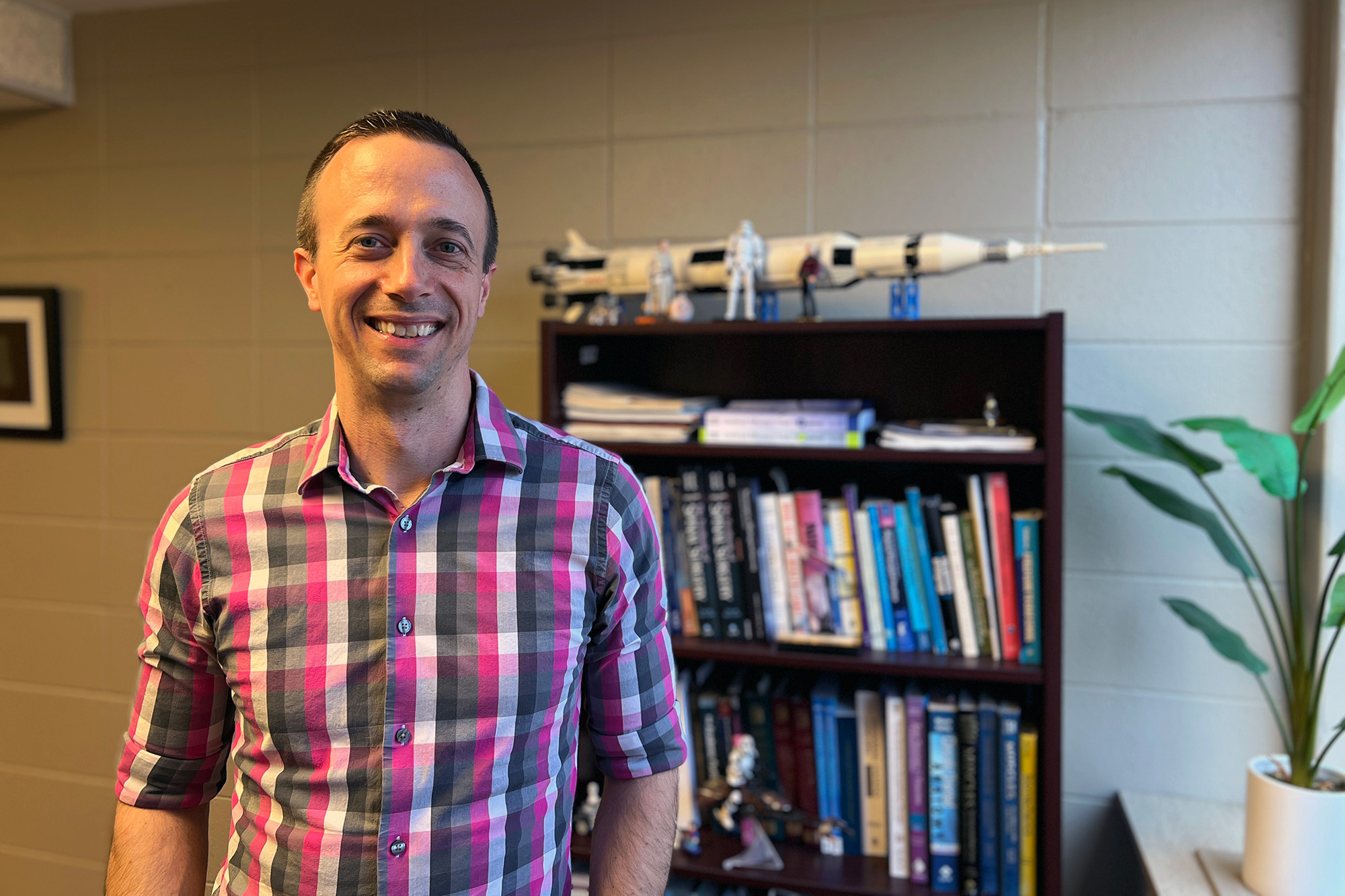
Bill Janes is on a mission to improve life for people with amyotrophic lateral sclerosis (ALS). As a licensed occupational therapist and researcher at the University of Missouri, he’s seen firsthand how the disease can steal a person’s strength, speech and independence.
ALS damages the nerve cells that control muscle movement, causing weakness and trouble with speaking, swallowing and breathing. But the disease doesn’t look the same for everyone. Some people decline quickly, while others lose function gradually.
To help close those gaps in care, Janes is working with experts at Mizzou’s School of Medicine and Institute for Data Science and Informatics to build a smarter way to track ALS progression in real time. Their solution uses a combination of in-home sensors and artificial intelligence.
“Right now, we’re essentially blind to what’s happening between clinic visits,” Janes, an assistant professor in Mizzou’s College of Health Sciences, said. “With these sensors, we can detect subtle shifts in health sooner — sometimes even before a patient feels them — and act before a crisis occurs.”
Smart health monitoring
Curators’ Distinguished Professor Emerita Marjorie Skubic at Mizzou’s College of Engineering and Curators’ Distinguished Professor Emerita Marilyn Rantz at Mizzou’s Sinclair School of Nursing originally developed the sensors to monitor the health of older adults living at home. The devices can detect changes in behavior and physical activity, including walking and sleeping patterns, prompting health care interventions that can delay or prevent serious health events.
Now, Janes and colleagues are adapting the sensors to fit the needs of ALS patients, whose functional decline often mirrors that of older adults but progresses more rapidly and unpredictably.
Right now, the team is focused on verifying that the sensor data accurately reflects real-world changes in how patients function day to day. Their next phase will make sense of the collected data using predictive modeling.
The data flows wirelessly through two small boxes in the home, then securely transfers to university systems, where researchers can study the results. Using machine learning, a type of AI, predictive models are built to estimate each patient’s score on the ALS Functional Rating Scale Revised (ALSFRS-R) — a clinical tool that measures how ALS affects a person’s daily abilities over time, including walking, talking, swallowing and breathing.
Leading the project’s data science efforts is Noah Marchal, a research analyst in the School of Medicine and a PhD candidate in health informatics at Mizzou’s Institute for Data Science and Informatics.
“Our goal is to not just track changes after they happen; we’re also trying to see them in advance,” Marchal said. “For example, we want to be able to detect a problem in gait or respiration before it causes a fall or hospitalization.”
When Janes recognized how the sensors could transform ALS care, Marchal helped bring that vision to life with guidance from his advisor, Xing Song, an assistant professor of biomedical informatics in the School of Medicine.
Balancing innovation and privacy
For the final stage of the project, researchers will integrate the system directly into clinical workflows. If the model predicts a concerning decline, a clinician could receive an alert to check in with the patient, adjust medication, recommend assistive devices or suggest further treatment.
Early feedback from participating families has been positive as many appreciate the sense of connection and peace of mind the system provides.
“Our vision is that one day clinicians will have a secure portal where they can view a patient’s daily health trends the way ICU teams monitor telemetry,” Janes said. “It’s about giving people living with ALS — and their care teams — the information they need, when they need it.”
While the current project focuses on ALS, this same technology could be adapted to help monitor other chronic conditions, such as Parkinson’s disease or heart failure.
The study, “Enhancing ALS progression tracking with semi-supervised ALSFRS-R scores estimated from ambient home health monitoring,” was published in the journal Frontiers in Digital Health. Sheila Marushak and Mihail Popescu are co-authors.


