March 10, 2026
Contact: Eric Stann, StannE@missouri.edu
Photo courtesy Zach Borowiak
For University of Missouri sophomore Zach Borowiak, listening to St. Louis Cardinals games in the Missouri Bootheel was a family ritual. Every game brought generations of his family together to his great-grandmother’s living room in Cape Girardeau, where the sounds of Busch Stadium spilled from her radio.
It quickly became the soundtrack of his childhood.
The Cardinals’ unforgettable 2011 World Series run was a defining moment. As third baseman David Freese cemented his status as a hometown hero and slugger Albert Pujols delivered postseason magic, Borowiak found himself fully captivated. And while many young fans gravitated toward Yadier Molina’s highlight-reel defense, Borowiak was drawn to the numbers behind the brilliance.
Batting averages. On-base percentages. WHIP. He could recite them all. The numbers didn’t just explain the game; to him, they were the game.
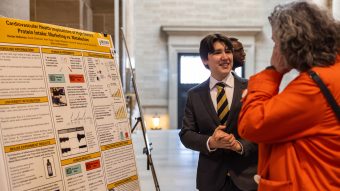
Now, as a student at Mizzou’s College of Arts and Science, Borowiak is taking his passion for the game to Undergraduate Research Day at the Capitol, where he’ll showcase his work in sports analytics, the fast-growing field in which data and predictive modeling help players and coaches make more informed decisions.
The annual event highlights studies that students are conducting across the University of Missouri System’s four campuses. At Missouri’s Capitol in Jefferson City on March 12, Borowiak will join nine fellow Tigers to present research on health care, agriculture, technology and more to lawmakers, policymakers and other state officials.
A new way to look at the game
Borowiak’s goal isn’t simply to study baseball — it’s to help shape its future. His research questions what each pitch can tell us about the bigger picture of the game.
For answers, he teamed up with Mizzou Assistant Professor Charles Steinhardt to build a machine learning model that evaluates how well pitchers, hitters and catchers perform. Using public data from Statcast, Major League Baseball’s advanced player-tracking system, the pair uncovered several surprising patterns.
One key finding: Hitters at the top of the order start strong and get even better as the game progresses, while those at the bottom show little improvement. That gap may help explain why pitchers often struggle the third time through the order — not just because of fatigue, but because hitters are adapting.
“Hitters are often trained to let the first strike go by as part of their strategy, which leads to low batter scores even when the pitch could be hit,” Borowiak said. “As a result, pitchers are more likely to throw the ball down the middle because they think the hitter won’t swing.”
His model also suggests that, despite conventional wisdom, hitters do try to guess the next pitch. When pitchers repeat the same pitch, hitters who guess wrong see their performance dip — a small miscalculation that can tilt the momentum of a game.
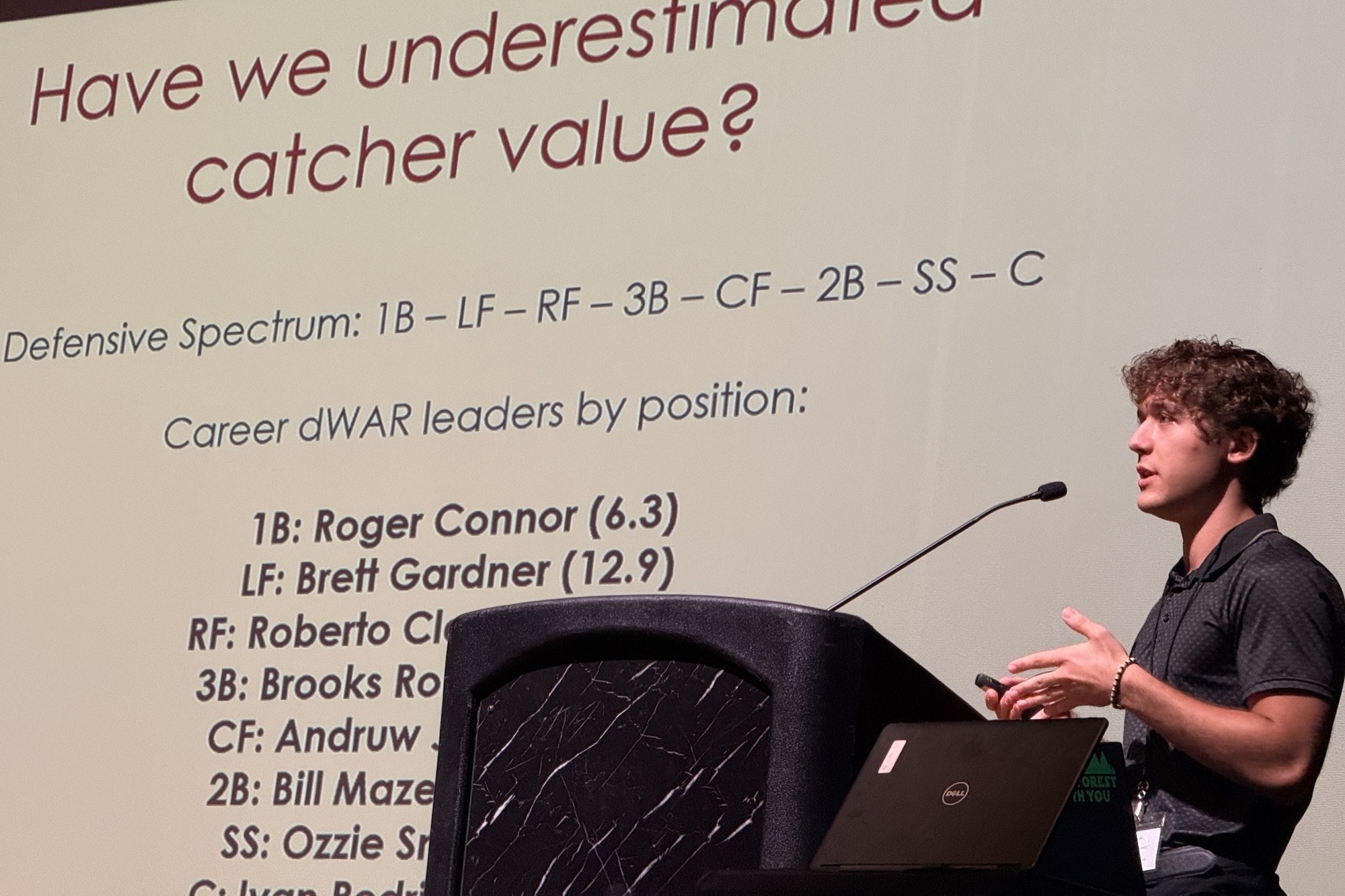
And that guesswork highlights just how valuable a catcher can be.
For years, analysts believed an elite catcher could save about 20 runs per season through pitch framing — subtly shifting the glove to make borderline pitches look like strikes. But Borowiak’s machine learning model points to a dramatically larger impact. The best catchers, he found, could save closer to 100 runs — roughly equivalent to adding 10 wins in a season.
His work also shows that the value of a great catcher goes far beyond expanding the strike zone. Elite catchers coax hitters into swinging at pitches they normally wouldn’t, often resulting in weak contact. Combine that with their ability to call the right pitches and disrupt a hitter’s expectations, and their influence on run prevention becomes even clearer.
“The value of the catcher framing could be two to three times greater than previously believed, so having a catcher who is an excellent defender — but otherwise a poor hitter — can be a considerable bargain for a team’s payroll,” Borowiak said.
These findings could reshape how teams scout catchers, build rosters and make in-game decisions. Analysts from Missouri’s two Major League Baseball teams have already offered positive feedback on his work.
Borowiak is part of a growing wave of innovators using data not just to explain performance, but to predict it. His research hints at a future where baseball strategy leans more on machine learning than intuition — and where every pitch holds a piece of the larger story.
In addition to highlighting the work at Undergraduate Research Day at the Capitol, the study, “Hitter and catcher adaptation in Major League Baseball,” was recently published in Baseball Research Journal, a journal of the Society for American Baseball Research.