Feb. 18, 2026
Photo by Kolden Lam
Hope Schust didn’t expect to lead a robotics project in an occupational therapy (OT) lab at the University of Missouri. As is often the case in OT, however, necessity is the mother of invention.
After graduating from Mizzou with a bachelor’s degree in health sciences with an emphasis in health and wellness, Schust was focused on applying to occupational therapy programs in the College of Health Sciences. One option stood out: creating a robotic arm designed to assist people with disabilities in everyday tasks.
“I was super intimidated,” Schust said. “I didn’t do anything with robotics before. The assistive technology I was aware of was simpler, like bottle openers or something that helps you zip a jacket. So, when Dr. Janes said robotics, I had to take a second.”
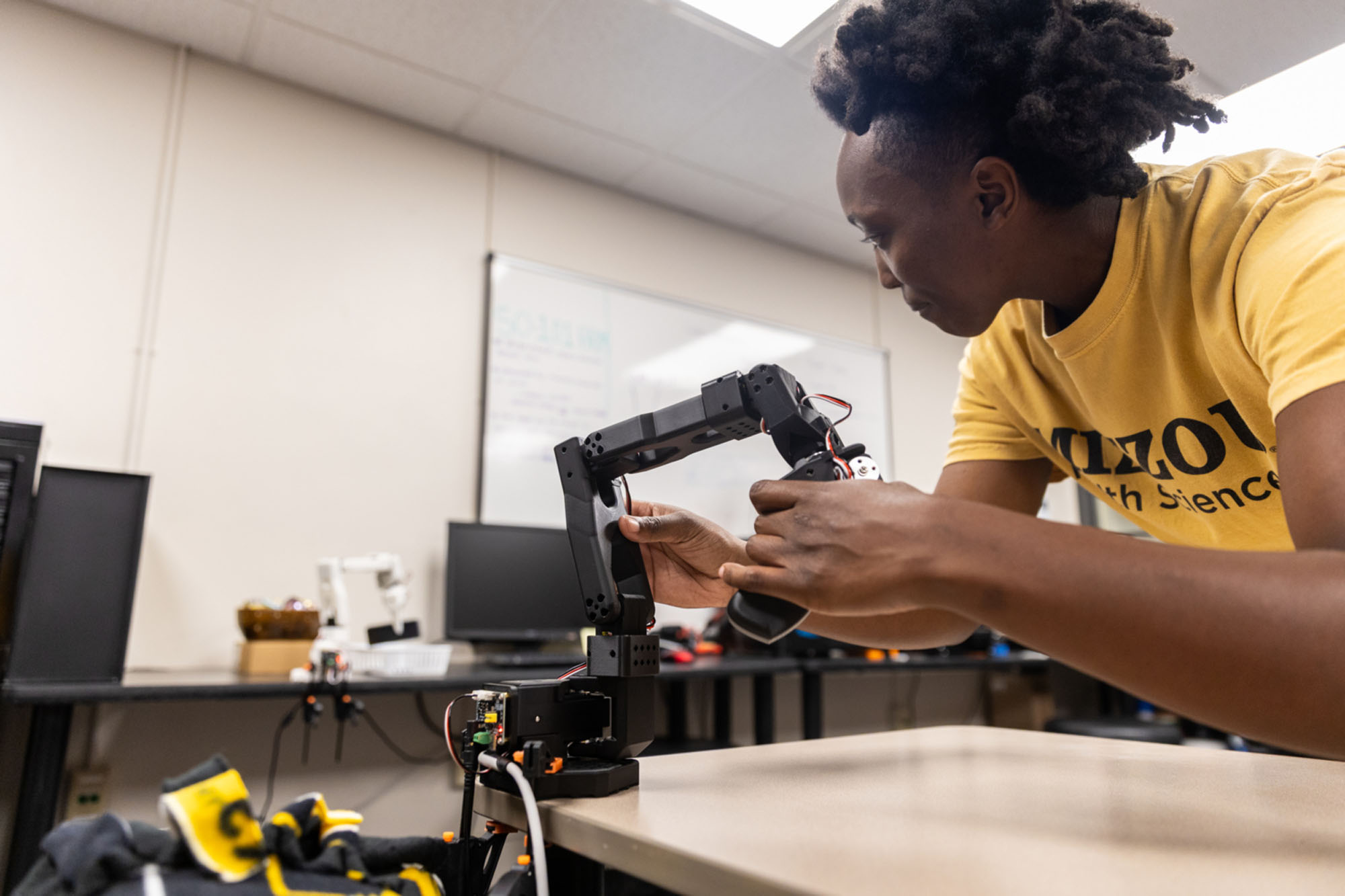
That moment of hesitation was short-lived, eventually giving way to plenty of hands-on innovation. Working alongside senior computer science student Braeden Songer, Schust dove into open-source robotics and learned how the device could come together to create meaningful outcomes.
The robotic arm is part of a broader push to make assistive technology more accessible and affordable. Most of the components were 3-D printed in the lab, with only the motors and wiring shipped in.
The team is now working to explore AI algorithms that could allow the arm to perform tasks without manual control, such as picking up a pencil or responding to voice commands. A mounted camera might be able to give the arm visual perception, allowing it to view objects and interact with its environment through autonomous programming.
Assistant Professor Bill Janes’ Assistive Technology Adaptation and Training (AT-AT) lab uses primarily open-source maker technologies such as 3D printing, microcontrollers and toys to create customized assistive technologies. While rehab professionals and designers naturally are enamored with the potential of new assistive technologies, Janes said his lab tries to focus mainly on the needs of end users.
“We are surveying assistive technology providers across the country and meeting people with complex motor difficulties,” Janes said. “We are talking with people who use existing robotic arms to figure out where they fall short. It’s not enough to figure out what the robot can do. We want to know if it can do what people need it to do.”
From assisting people who have cerebral palsy or multiple sclerosis to supporting seniors with limited mobility, Schust said the robotic arm could be mounted on a wheelchair, placed on a desk or even installed in a car. The surveys the team has conducted also turned up numerous suggestions for the device.
“One idea was brushing teeth,” Schust said. “Another was holding a phone and moving it closer or farther away. It’s all maybes and hypotheses about what it can do right now, but they’re exciting possibilities.”
Janes and Schust said the project would not have been possible without the assistance of the MO Better Foundation, which provided funding. While the jury is still out on the broader impact of the SO-101 for occupational therapy, Janes sees it as “the first step toward an affordable option to help people complete some simple daily tasks and live more independently.”
Schust agrees, viewing the project as far more than a technical challenge. It’s a chance to rethink what’s possible in occupational therapy and to bring new tools into the field — even projects that might seem intimidating on the surface.
“Especially with OT, there are a lot of advanced devices and situations that can feel overwhelming,” Schust said. “I’m learning not just to be comfortable doing the things I know, but to step outside and try something more advanced and maybe find out that I’m good at it.”
Read more from the College of Health Sciences