Published on Show Me Mizzou Dec. 17, 2025
Story by Mara Reinstein, BJ ’98
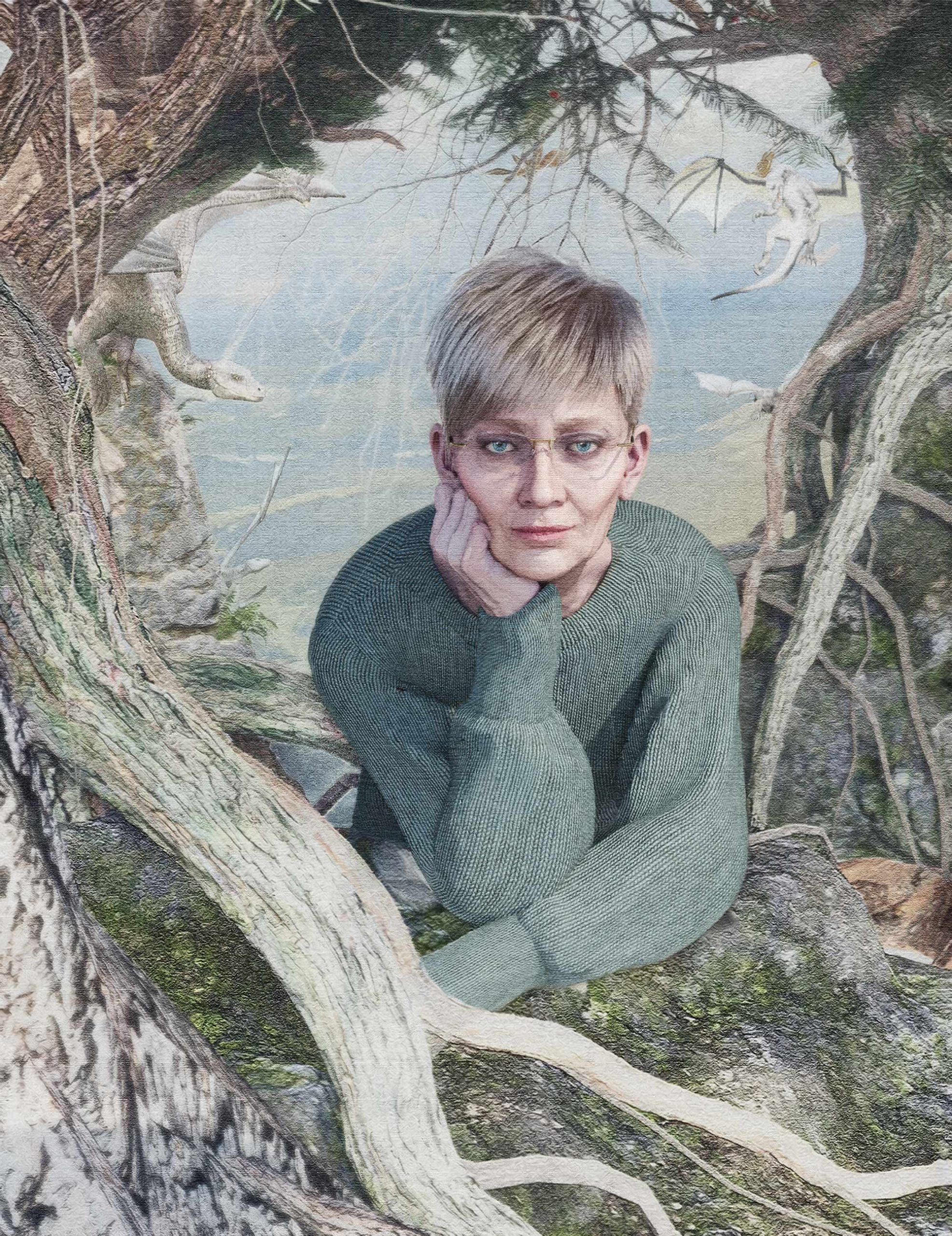
Go to Milwaukee, Wisconsin, and head southwest about 40 miles. You’ll arrive at a resort town called Lake Geneva. Somewhere on the outskirts is a converted barn that has stood for more than a century. Right at this very moment, author Margaret Weis likely is sitting inside furiously typing about the mystical adventures of the Solamnic Knight Huma and the Wizard Magius.
“I write every day,” she says. “I have contracts, and I have two dogs to support. And I still love working with words.”
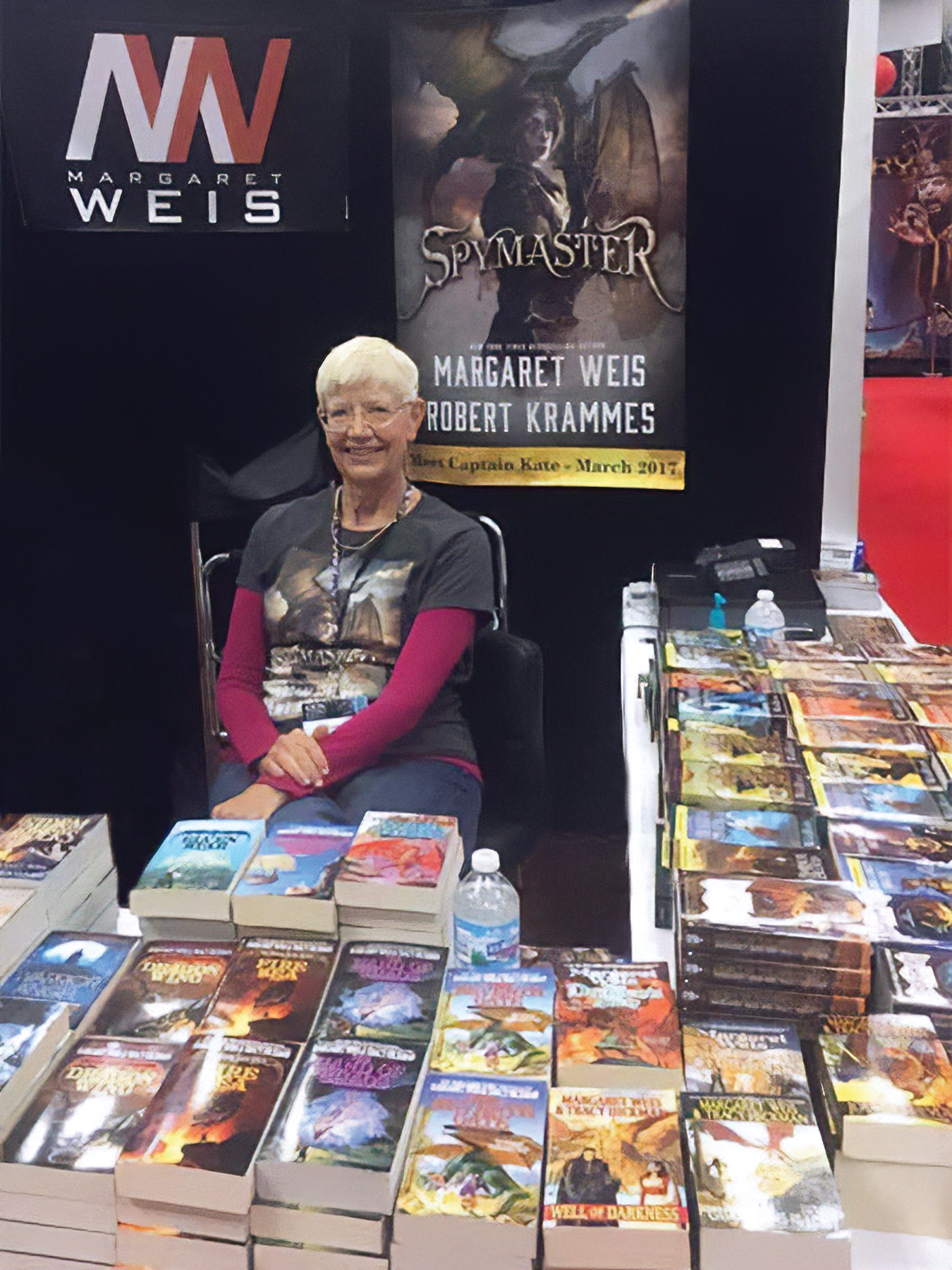
Weis, BA ’70, stands as one of the defining fantasy and science fiction voices of the past half century, a writer whose invented world of Krynn has become bedrock for generations of Dungeons & Dragons players shaping their own adventures. A New York Times bestselling author well into her fifth decade of writing, she’s penned so many series and trilogies that she freely admits she “has no idea” how many books feature her name. (The answer is 65 if you believe Wikipedia.) She doesn’t even have the space in her office to store them all. “I run out of room, so I keep giving them away,” she says. “I only have my research.”
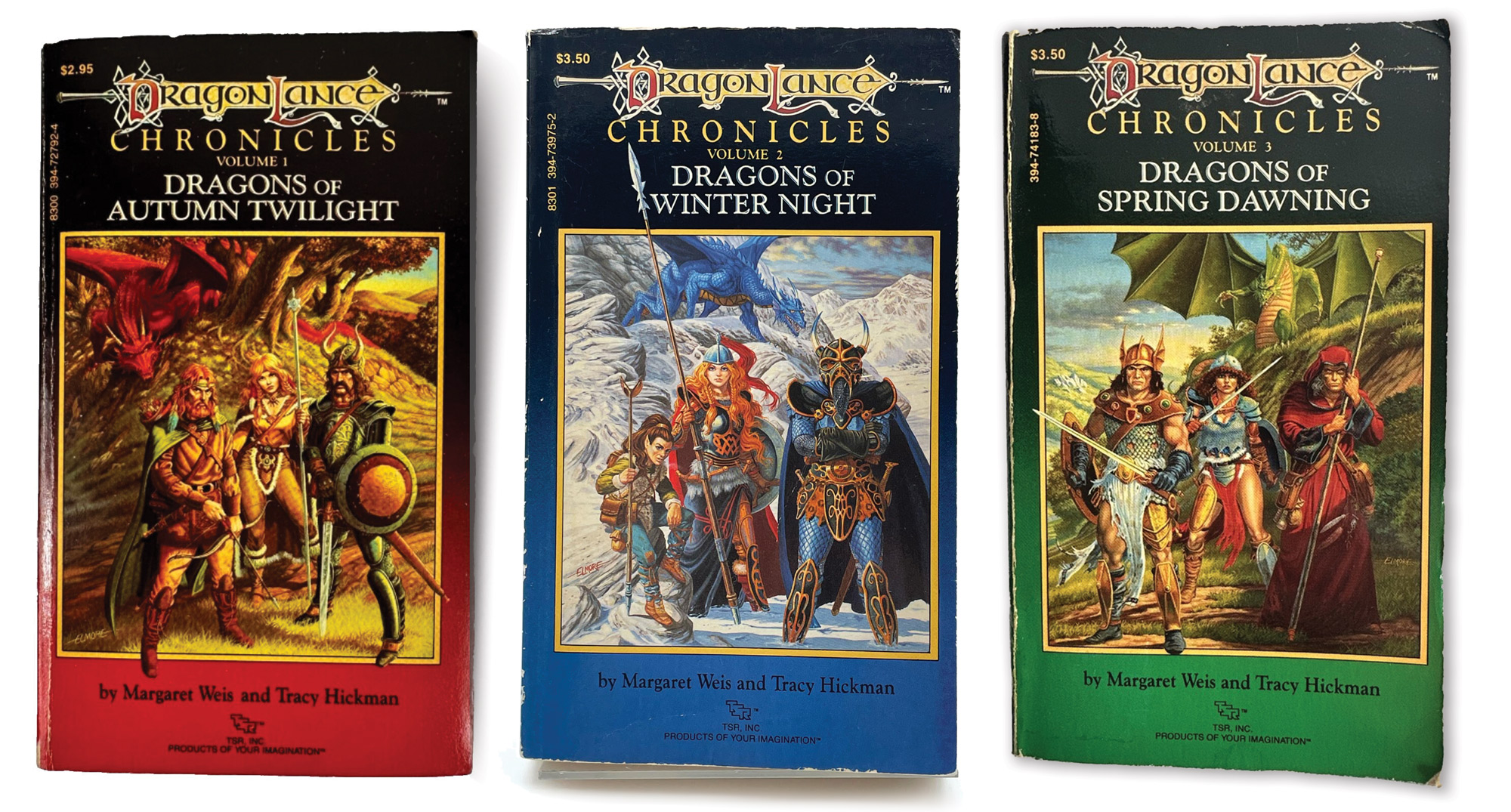
Most famously, Weis is one of the original creators of the Dragonlance saga. Fan conventions and internet forums run down all the details of this magical forgotten realm, but here’s the bottom line: In the four decades since its first edition, the Dragonlance series has collectively sold more than 25 million copies and been translated into multiple languages.
The numbers hardly tell the whole story, though. Just look at Reddit, a crucial online hub for fandom. “If I had not read those books when I was a young kid, my life would have been so much different,” wrote one reader in a Dragonlance thread. “One of those few things that I can point to and say that it was truly life changing.”
Weis and co-author Tracy Hickman returned to the fold a few years ago with a new trilogy, Dragonlance: Destinies (out in paperback). During a recent call, she was in the revision stage on the first book of another new Dragonlance series, War Wizard, featuring “a very famous wizard in the Dragonlance lore called Aegis and his friend, who was a Knight of Solamnia,” she says. It will be published in August.
In a fantastical, ever-expanding lore filled with sorcerers, dwarfs, bards, wizards, witches and dragons, Weis is the very real queen. Among her loyal subjects — er, fans — is actor, writer and host Joe Manganiello.
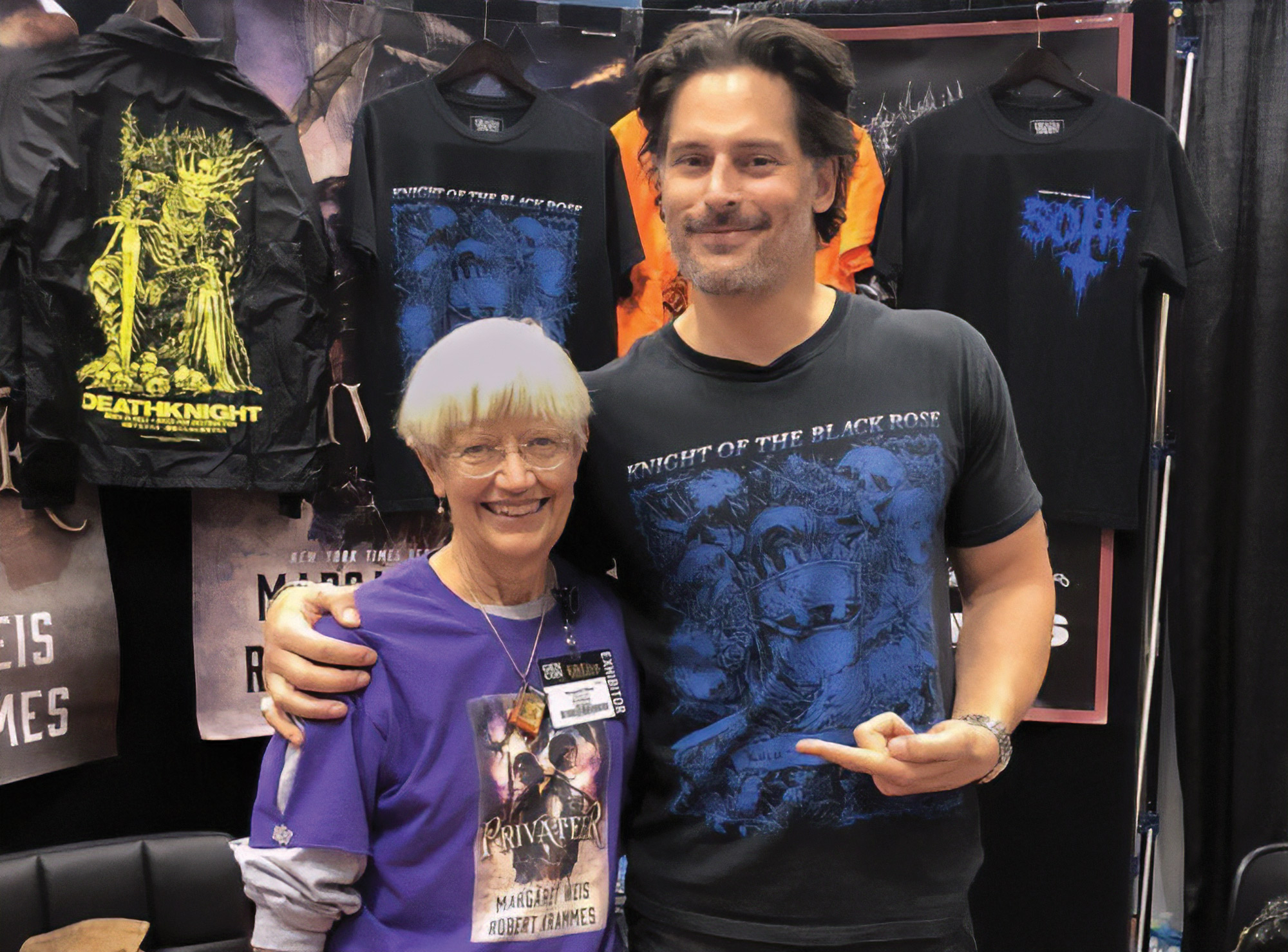
Best known for roles in Magic Mike, True Blood and Sam Raimi’s Spider-Man films, the actor is a D&D die-hard and franchise entertainment consultant who first met Weis in 2018. They were both at a meeting to map out the relaunch of the fifth edition of Dungeons & Dragons Dragonlance: Shadow of the Dragon Queen.
“Margaret is so funny and wily and mischievous in a hilarious way, and the juxtaposition of these multifaceted personality traits makes her a great writer,” Manganiello writes via email. “She’s not afraid to let her thoughts and feelings out through these characters, which is why all her characters have such different voices. She’s a pioneer who doesn’t get the credit she deserves.”
Session zero
It never occurred to a young Weis to be a professional writer. Sure, the Independence, Mo., native had a passion for reading and writing. She committed to Mizzou because it offered a creative writing program. Nonetheless, she majored in art.
Then one day during her freshman year, a student teacher instructed her to stay after class. “I thought I was in trouble,” Weis says. Instead, the teacher gushed about her talent and suggested that she switch majors to literature and creative writing. “I’ve often said it was like when John Belushi decides he’s going to put the band together [in The Blues Brothers],” she recalls. “He looks up to the sky, and the heavens opened.”
Being a student in the late 1960s had a profound impact. Never mind that the only protest she attended was to oppose the closing of a popular bar called the Huddle Club. Mizzou was where she discovered fantasy author J.R.R. Tolkien’s books. “In the days before the Internet, students spread the word by hitchhiking,” she says. “Students would come from the West Coast bringing along copies of Lord of the Rings. Eventually we saw it in bookstores and started reading it.” The book’s themes of resistance, anti-industrialism and friendship across cultural divides “came to symbolize the protests against the Vietnam War.”
Weis returned to Independence after graduation and, at her mother’s urging, clocked in as a proofreader for the publishing arm of the Church of Jesus Christ of Latter-day Saints. She got married, had two kids and ended up spending 11 years on the job.
Then, in the immortal words of Belushi’s “Joliet” Jake, she embarked on her mission from God.
An article about an ascendent gaming company caught her eye as she perused Publisher’s Weekly in 1982. Tactical Studies Rule Inc. (TSR) was formed in 1973 and first headquartered in a Wisconsin basement. Fueled by a growing interest in fantasy fiction, TSR’s decade-old game Dungeons & Dragons had recently become a phenomenon. “I thought, ‘Wow, that would be such a neat game for my kids and I to play,’ because it was completely based on the imagination,” she says.
A few months later, Weis spotted a job listing for a TSR games editor. She failed the interview pre-test miserably, but no matter. Jean Rabe, a TSR books editor, was looking for someone to edit a series to dovetail with a new role-playing game module co-created by Hickman. It was titled Dragonlance. “The editor found my application in the games department and contacted my agent,” she says. “I had lunch with her and was hired that day.” She packed up her family and two cats and moved to Lake Geneva, Wisc.
As Weis immersed herself in the world, she and Hickman soon realized the only people equipped to write these books were staring back at them in the mirror. Hickman, who had developed the Dragonlance setting with his wife, Laura, kept designing the game while Weis — whose storytelling instincts meshed well with his world-building — wrote the prologue and first six chapters in a single weekend.
“Jean told me years later that she only agreed to read our stuff because she didn’t want to hurt our feelings,” Weis says. Instead, Rabe ended up bowled over by the results, and the Dragonlance Chronicles were born.
The first volume, Dragons of Autumn Twilight, was published in November 1984 and became an instant New York Times bestseller. “It was stunning!” Weis says. “I had never in my wildest dreams imagined this.” Even her tough-to-please mother, who envisioned her becoming the next Joyce Carol Oates, came around to embrace the success. “She bragged that she was the grandmother of one of the characters.”
As Weis penned more books throughout the decade and beyond, her legend grew. “If you played D&D, especially in the 1980s, you would have definitely read her books,” says Francis Huang, an education professor at Mizzou and a fan since his youth. “She created this whole world where people could identify themselves with these mystical characters. And the dragons ruled in her books. That was a big thing, because who doesn’t love dragons?”
Manganiello started poring over her novels in the mid-80s. “I loved how the mythology was used to discuss topics of codependency, war, race, loves and loss,” he writes, noting that she was a trailblazer, as well: “In a world oversaturated with one-dimensional girl-boss archetypes in fantasy, Margaret was introducing multilayered female characters. People don’t understand how ahead of her time that was back then.”
Weis, in turn, credits her readers for her longevity. “They’re the ones who put our books on the Times list and gave us the freedom to do more books,” she says. “Now it’s been 40 years with them. It’s been a wonderful ride.”
The next campaign
Occasionally, Weis does like to venture outside the barn. She and Hickman are frequent presences at the annual Gen Con, the largest tabletop game convention in North America. At the 2025 edition in Indianapolis, she hosted a Dragonlance celebration panel, signed books at the Penguin Random House booth and spent hours greeting readers. “It’s just so much fun because I love to meet the fans,” she says.
She has yet to return to Mizzou since graduation, but not for lack of affection. “My parents moved from Missouri, so I don’t have ties there anymore and haven’t been inclined to go back,” she explains. “I just want to keep the memories, because they were really, really, good.”
After her Lord of the Rings spiritual awakening, Weis stopped reading fantasy books. Now she loses herself in mystery and romance novels. She’s just made her way through all of Rex Stout’s works in chronological order. She still loves the classics of Charles Dickens and Jane Austen. Weis and her daughter, Lizz, once wrote two paranormal romance books together, Warrior Angel and Rebel Angel, “because we thought it would be fun.” (Lizz is an investor at JP Morgan; Weis’ son, David, died years earlier.)
Although Manganiello had signed on to write and produce a Dragonlance live-action streaming series based on the first six core books and scripted a pilot episode, the project was cancelled in 2024. The actor says he still “has the dream to bring them to life on the screen.”
Still, fans have reason to be optimistic about potential new action on Krynn. In October, Wizards of the Coast — the Hasbro-owned publisher behind Dungeons & Dragons and Magic: The Gathering — revealed that Weis and Hickman are returning to the fold. This time they’ll join forces with Manganiello on new Dragonlance projects.
The announcement, shared on social media by D&D head Dan Ayoub with a wink toward “amazing things ahead,” sent fans into a frenzy over what could be the long-awaited revival of one of the game’s most treasured realms. Weis welcomes the excitement but isn’t tempted to tackle a screenplay, were there to be one. “My talent doesn’t lie in that direction,” she says.
Besides, she’s got plenty of books yet to write. Not just because she has contracts and dogs. Not even just because she has a passion for it. As she puts it, “I just wouldn’t know what to do with myself.”
shield
Dungeon Diving Downtown
Hexagon Alley’s Dungeons & Dragons nights are open to adventurers of all XP levels.
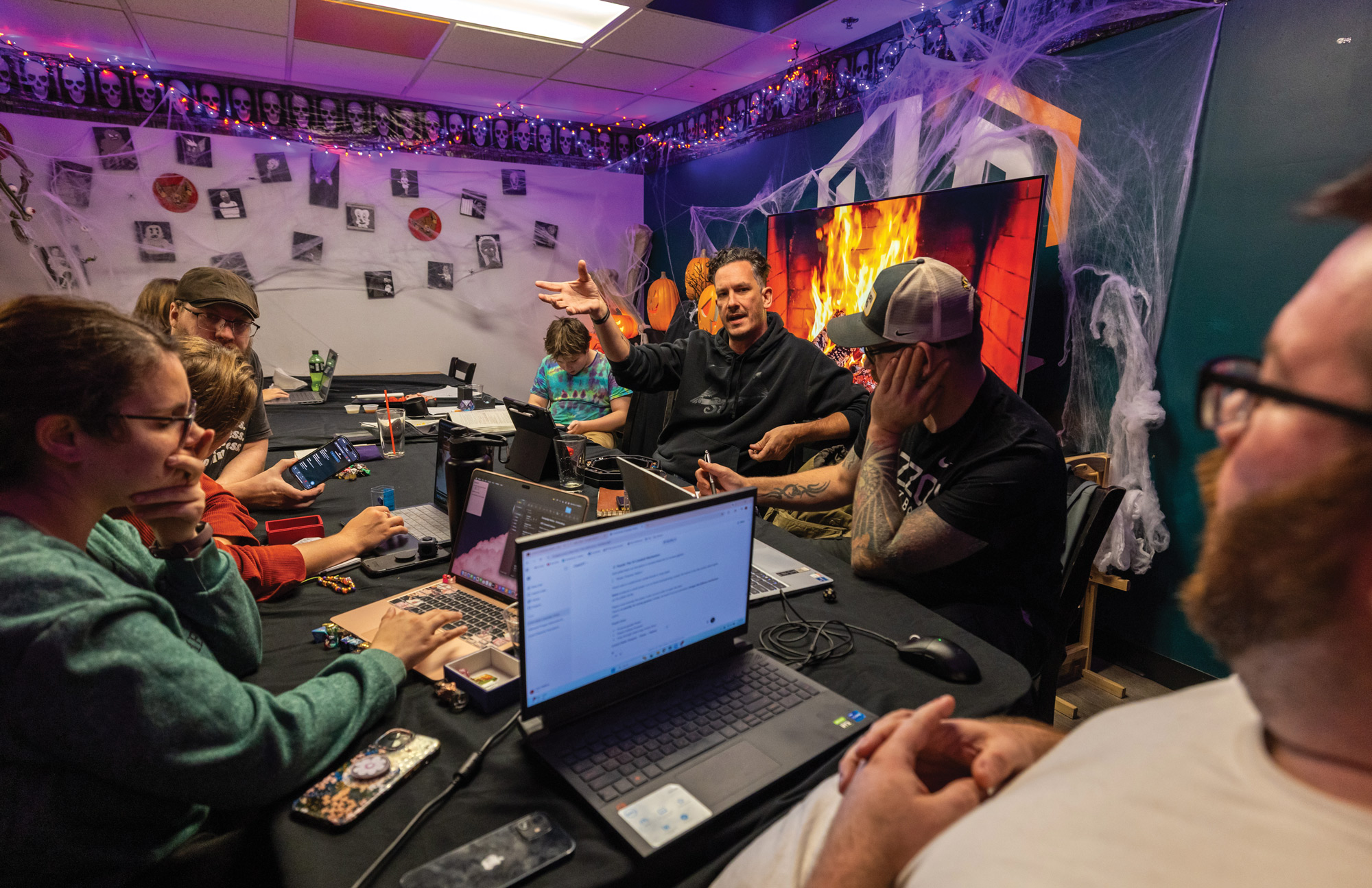
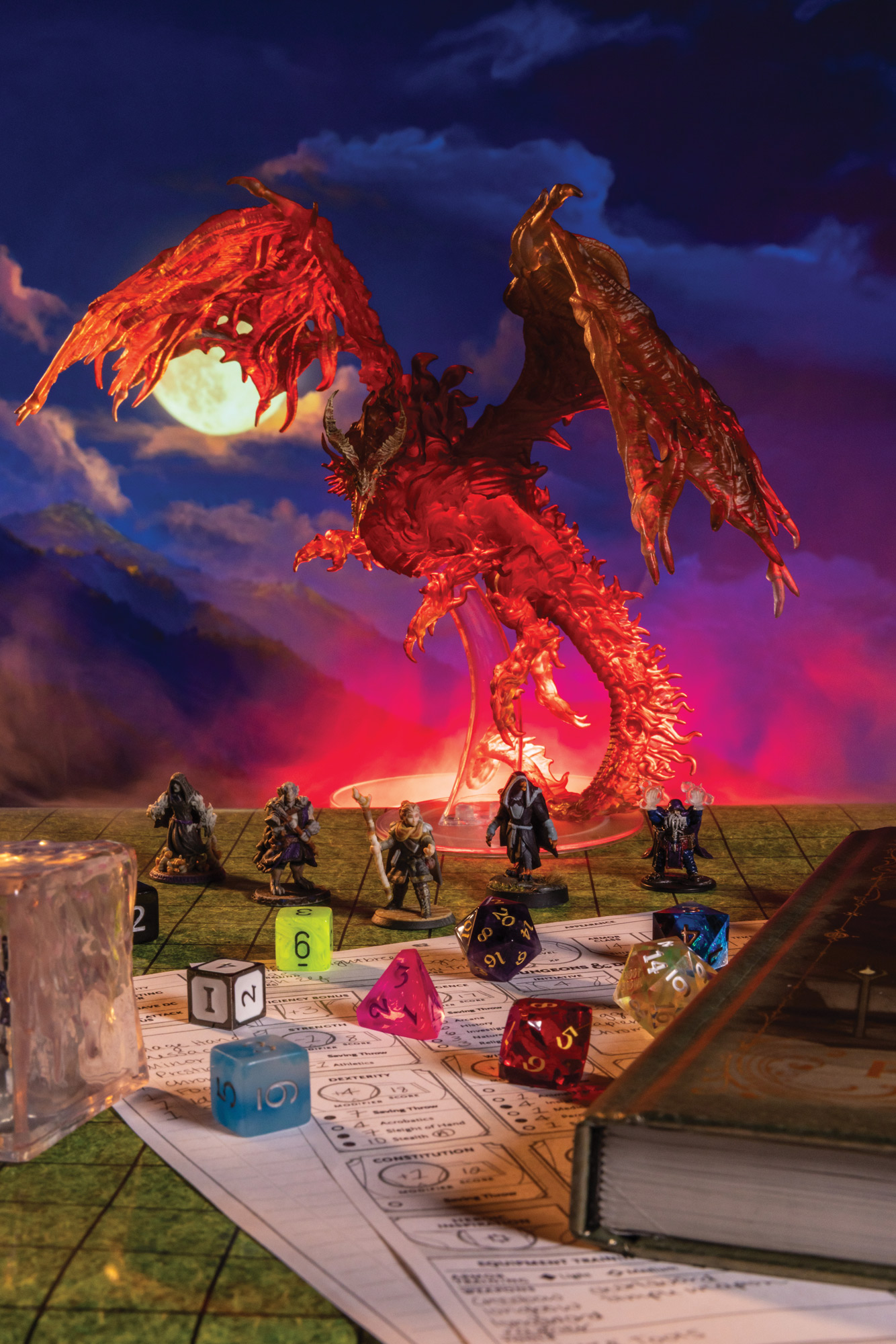
The dance of a 20-sided die, illuminated by the golden glow of a fresh pint of pale ale. Metallica riffs churning in the background. The call of the dungeon master (DM) orchestrating a campaign: “Roll for initiative!”
These sights and sounds are typical during Dungeons & Dragons night at Hexagon Alley in downtown Columbia. Located in the space once occupied by dance club Shattered!, the board game cafe has become a haven for the long-running tabletop fantasy RPGs (role-playing games). On Monday evenings, aspiring adventurers can participate in D&D “One Shots” — self-contained campaigns that can be completed in one sitting.
“We want as many people as possible, at any skill level, to come in and give it a try,” says Hexagon Alley employee James Long, who curates the D&D events. “If you’re someone who’s looking for that larger experience in gaming, the Monday night sessions are the perfect ones to get into.”
First published in 1974, Dungeons & Dragons is now in its Revised 5th Edition ruleset. Although the basic concept remains the same: Players create and roleplay a character, dungeon crawling with their fellow party members. The rules have expanded vastly since then. As Long notes, this evolution has added to the creative freedom that makes D&D so unique.
“There are more rules, but there are more possibilities,” Long says. “It’s one of the first rule books — Dungeon Master’s Guides — to emphasize that the rules are merely there to be a basis. They’re open to interpretation; they can be changed as the DM and players want. You’re welcome to make it your own.”
In the 50-plus years since the game was designed by Gary Gygax and
Dave Arneson, D&D’s player base continues to grow and transcend generations. Long says a typical table at Hexagon will include players of all ages, upstarts and veterans alike.
“It has this appeal because it taps into a very childlike wonder that we get from playing games,” Long says. “It gives people the tools, the resources and a space to use their imagination.”
For those who can’t make it to Monday D&D nights, Hexagon also runs a matchmaking service to help players seeking campaigns connect with one other. A signup survey can be found on hexagonalley.com. — Jon Hadusek, BJ ’12
To read more articles like this, become a Mizzou Alumni Association member and receive MIZZOU magazine in your mailbox. Click here to join.