Dec. 4, 2025
Contact: Sara Diedrich. diedrichs@missouri.edu
Armed with a $5,000 Entrepreneur Quest (EQ) award from the University of Missouri and a bold idea to reinvent the future of 3D printing, Trent Esser, BSBA ’20, and Hayden Seidel, BS CiE ’20, have transformed their student startup into a multimillion-dollar enterprise expected to exceed $10 million in revenue next year.
That’s the power of Mizzou: fueling ideas that change lives and transform industries.
Today, their company, Printerior, has emerged as a St. Louis–based leader in circular additive manufacturing. Whether producing 3D printer filament, small-scale products or striking large-format architectural designs — all made from waste plastic the company collects and recycles — Printerior is redefining sustainable manufacturing.
The results speak for themselves.
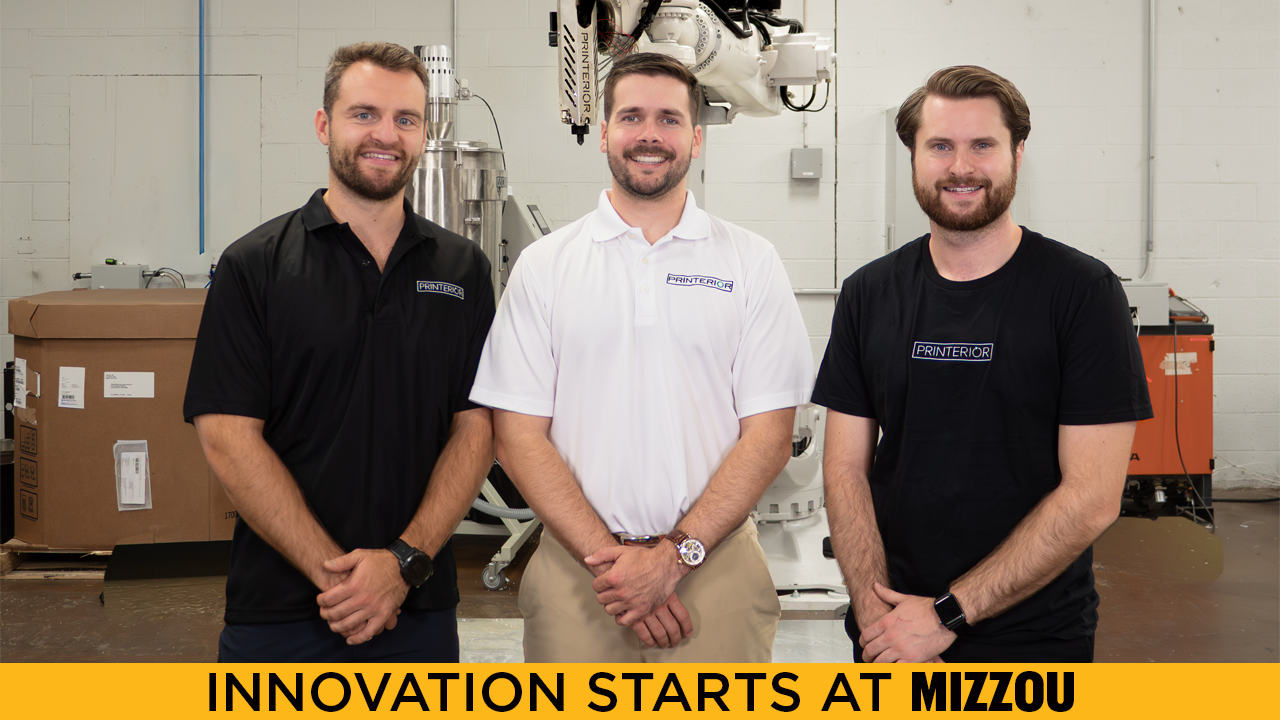
This year, the company is on track to reach nearly $4 million in revenue. With CEOs Esser and Seidel now joined by Chief Technical Officer Jordan Backes, BS CiE ’17, the team recently launched a new subsidiary and anticipates doubling warehouse space next year.
And it all started with Mizzou’s EQ, a “Shark Tank”-like competition that allows students to pitch business ideas and compete for funding and mentorship.
“Being part of the second year of the EQ program was especially valuable,” Esser said. “It gave us the chance to pitch a bold idea, validate it and eventually secure seed funding. That experience was a major stepping stone. It proved our concept and set us on the path we’re on today.”
What truly sets Printerior apart is its end-to-end mastery of process. The company engineers every component, from developing its own materials to designing and building its printers, ensuring complete control over production.
“This approach, combined with our advanced automation systems, gives us a significant competitive edge,” Esser said. “We’ve spent years developing a technology stack that coordinates all robotic operations, quality control and product management through a fully integrated digital system.”
The payoff is a seamless, highly automated workflow that delivers efficiency and scale at a level few competitors can match, Esser said.
All roads lead to Mizzou
Esser and Seidel grew up in Wildwood, just outside St. Louis, and met their freshman year of high school where they became friends. When it came time to choose a college, Esser’s drive for business pulled him to one place: Mizzou. Seidel followed suit, pursuing his interest in civil engineering.
Esser discovered that Mizzou was a powerhouse of entrepreneurial opportunity, driven in no small part by Greg Bier, the former director of the Entrepreneurship Alliance, whose mentorship and courses guided both him and Seidel. Bier and others from the Center for Entrepreneurship and Innovation, housed at the Robert J. Trulaske College of Business, gave them the support they needed to get started.
“They pushed us out of our comfort zones, required us to pitch and validate our ideas,” Esser said.
The idea (that almost didn’t get off the ground)
By his senior year, Esser had worked with several sustainability-focused startups in the construction industry. But he was eager for a new project when he heard about the EQ student accelerator and jumped at the chance to collaborate with Seidel, who had taken an interest in 3D printing.
“From my sustainability experience, I started thinking about 3D printing as a relatively new industry,” Esser said, adding that he wondered if anyone had explored using recycled polymers such as plastic as a material. “We realized there was almost nothing in the U.S. on large-format 3D printing using recycled plastic. It seemed feasible, though it would need significant fine-tuning.”
Mizzou recognized their genius.
In 2020, the university ignited their journey with a $5,000 EQ award and immersive, hands-on experiences that equipped them to navigate the unpredictable twists of launching a company from the ground up.
Rather than rushing straight into product manufacturing, Esser and Seidel focused on making feedstock — the raw material used in 3D printing — crafted entirely from recycled plastic.
Their breakthrough came in 2021, when a $50,000 grant from the St. Louis-based Arch Grants program propelled them to open their first facility. There, they began producing recycled filaments and pellets at scale, positioning themselves at the forefront of the 3D printing industry.
“This not only validated our approach but also gave us the funding and expertise to work toward our original vision of creating product-focused, end-use parts,” Esser said. “Over time, we leveraged the business to fund research and development and moved back to our initial goal of building a product-driven company.”
Hitting their stride
Today, Printerior has 13 employees and recently expanded into a 25,000-square-foot warehouse in the Chesterfield Valley area of St. Louis. Another major leap is already in the works for early next year, when the company plans to double its footprint, fueling even greater capacity and innovation.
“The past year has been a period of remarkable growth and momentum for us,” Esser said.
Printerior’s clients come from areas spanning consumer goods, automotive, aerospace and medical. Its operations are strategically organized into three business sectors, each driving the company’s vision forward.
“The first is our materials division, which represents the foundation of our company and the work we started with,” Esser said, referring to the feedstock and recycled filaments and pellets for 3D printers.
The second sector is the mass-production 3D printing division, a fleet of hundreds of printers churning out millions of parts every month. This isn’t just manufacturing; it’s manufacturing reimagined.
By vertically integrating every step — from inventing its own advanced materials to building proprietary software — Printerior has become a driving force in bringing manufacturing back to the U.S. Instead of relying on overseas production, costly molds and long shipping times, customers can simply upload their 3D design files, and Printerior will deliver domestic, high-volume output using recycled plastics. The company can even engineer those plastics with specialized properties, such as UV resistance for outdoor gear, fire resistance for safety equipment or antimicrobial additives for health care products.
The result? Faster turnaround, lower costs and smarter sustainability. When it comes to true mass-production 3D printing, Printerior is blazing a new trail in modern American manufacturing.
“It’s a completely new industry in the United States, one that doesn’t yet exist anywhere else at scale,” Esser said. “Currently, we produce about 3 to 5 million parts each month. Within the next few years, we expect that number to reach hundreds of millions. Achieving that growth will require expanding our infrastructure, refining our processes and scaling up sustainably to meet demand.”
The third and fastest-growing sector of Printerior is large-format 3D printing, a field redefining the architectural landscape. The company prints large wall paneling, divider screens, ceilings and exterior facades, while pushing design boundaries at scale.
Over the past 18 months, Esser has spearheaded a surge of innovation, driving this sector beyond its initial focus and into new U.S. markets.
“Right now, the surface design market offers the strongest opportunities,” he said. “In the architectural sector, we’re capable of outfitting entire buildings with our custom wall paneling systems. For now, our efforts are concentrated on this side of the market as we continue to build traction and scale.”
Printerior recently launched a new subsidiary specializing in large-scale components for the architectural industry and is already experiencing significant growth.
“We currently produce just under 1,000 large-format parts annually,” Esser said. “By next year, we expect that number to increase to between 6,000 and 8,000 parts.”
Making it work
The company’s momentum today, however, is the result of strategic planning.
For the first few years of operations, the team focused on front-end automation. Now, they’re shifting to an end-of-the-line automation system that uses robotics to pull, inspect and package parts. By March 2026, Printerior expects to reach full automation — with zero human involvement in production orders — making its entire manufacturing process fully autonomous.
“We’ve been running test simulations for the end-of-line automation over the past few months,” Esser said. “We’ll continue refining the process and gradually roll it out across the entire facility.”
So, what is the secret to the three Mizzou alumni working so well together?
“We each have our specialties, and we respect and trust one another to own them,” Esser said.
Backes leads the development of the automation systems, while Seidel heads the design department and serves as chief operating officer, overseeing operations, customer communication and education. Esser focuses on the overarching vision and manages inbound client relationships, building connections before handing them off to Seidel, who provides guidance and solutions.
“Everything is relationship-driven,” Esser said. “We’ve learned how to navigate that successfully. And we’ve been able to pivot when necessary. Mizzou taught us to embrace change, something we’ve had to do constantly since starting our business.”