Dec. 15, 2025
Contact: Sara Diedrich, diedrichs@missouri.edu
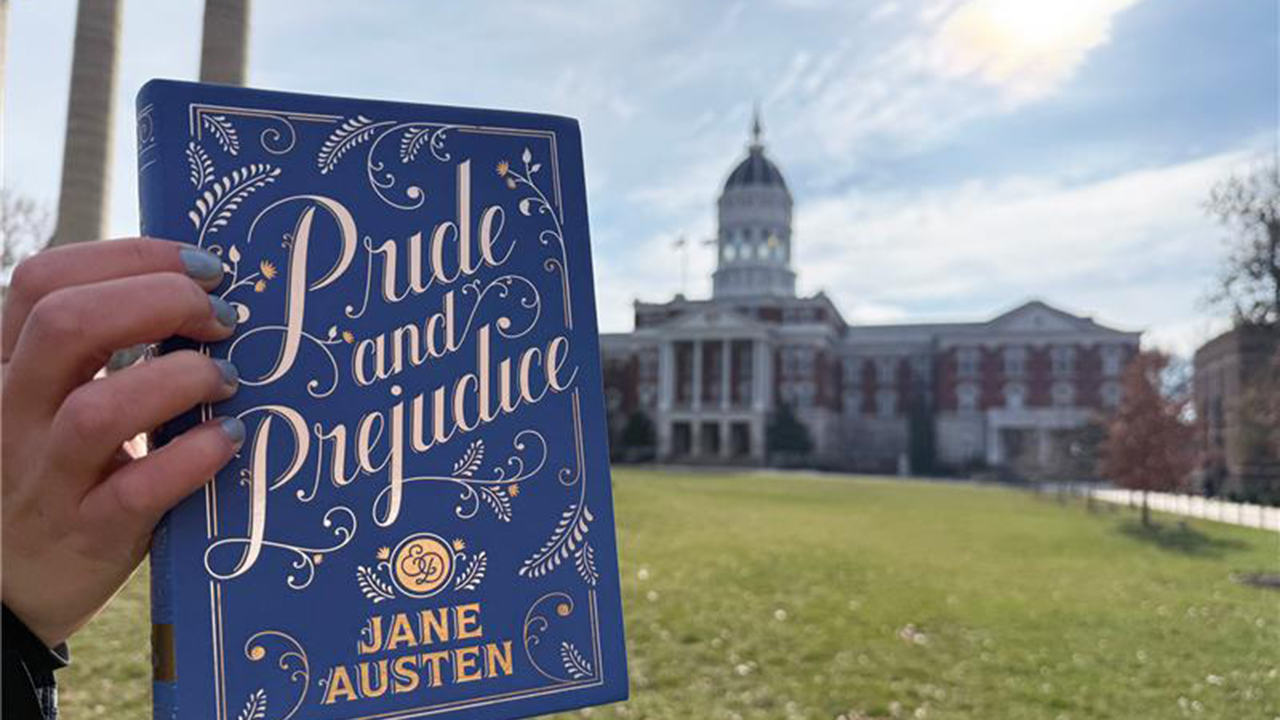
Photo by Jen Manning
Born 250 years ago, Jane Austen, the queen of Regency-era sass and razor-sharp wit, hasn’t lost her place in the spotlight. Her six iconic novels? Never out of print. They’re basically the Taylor Swift albums of classic literature: timeless, beloved and endlessly remixed.
And University of Missouri students in Professor Nancy West’s course on the legendary British novelist can’t get enough of Austen’s romantic musings, hot takes and pithy remarks.
“The class is a big hit, in part because the discussions are so lively,” West, an English professor in the College of Arts and Science, said. “Walking up the stairs, I can hear them all the way down the hallway, talking about the books.”
Enthusiasm for Austen, whose birthday is Dec. 16, isn’t confined to the classroom but spills into pop culture, influencing modern romance tropes.
From Keira Knightley twirling across the screen as Elizabeth Bennet in “Pride and Prejudice” to modern-day retellings that drop Austen’s heroines into Pakistan, Delhi, New York City and even a war zone, her stories continue to be reinvented. Her fandom is global, her devotees are fierce and her bold takes on love, class and society feel just as fresh today as they did in the early 1800s.
More than two centuries later, Austen proves that when written with class, pointed humor and social critique, swoony love stories never go out of style.
Why the enduring appeal?
West believes Austen’s long-lived popularity lies in the relatability of her characters and universal themes of friendship, growing up and falling in love.
“What always comes to mind is this: No matter how foreign her characters’ social behavior might seem — their language, mannerisms, gestures, even the odd bits of etiquette — once you strip all that away, they’re completely recognizable,” she said.
There is also the wisdom of Austen’s narrative voice — wry, observant and amused by human folly — that West says continues to draw in modern-day readers. Life, in Austen’s world, is a kind of comedy: Our missteps rarely matter for long, and everything keeps moving forward.
“She judges her characters sharply, but always with a comic spirit,” West said. “No matter how badly someone behaves, there’s still room for redemption. There’s real comfort in that voice, a steady assurance that we’re all going to be OK.”
Janet Saidi, an assistant professor and audio producer at the Missouri School of Journalism’s NPR-member radio station, KBIA-FM, recently wrote a biography titled “Jane Austen: The Original Romance Novelist.” She also has a blog and podcast devoted to the author. Saidi says Austen’s enduring appeal comes down to her “happily-ever-after” endings and the intricate formulas she crafted to get there.
“Some scholars call her the first detective novelist because there weren’t detective novelists at the time,” she said. “Austen was setting up clues and then giving you a resolution. But the resolution always involves ‘happily ever after.’”
Saidi said that, through her formula, Austen keeps readers alert by prompting them to examine the roots of knowledge, the nature of truth and the dynamics of power at play.
“Once you know that, you can’t unsee it,” she said. “It’s all over Jane Austen.”
Austen’s clever use of humor is another reason Saidi believes Austen’s books have withstood the test of time and continue to hold lessons for readers today.
“Austen shows us how to disagree with humor,” she said. “Her comedy often highlights the absurdities of social hierarchy, arbitrary power and inheritance laws. Writing in the Georgian era — a time of revolution — Austen had to be clever to question authority. By making us laugh, she wins our attention and our sympathy, subtly teaching us how to navigate the world with intelligence, courage and wit. She puts us on her side.”
Timeless lessons
West said many of her students relate to the perils of Elizabeth Bennet, the intelligent, witty protagonist of Austen’s 1813 novel “Pride and Prejudice,” who is compelled to examine her own character.
“Lizzy’s sharp, perceptive and proud of her quick mind,” West said. “She believes she understands people instinctively, but that confidence leads her to judge too quickly, and it gets her into trouble. Midway through the book, Lizzy is forced to confront that flaw. She essentially stops and says, ‘I thought I knew myself,’ and then realizes she has to reevaluate her assumptions, especially her own prejudices. It’s a moment that resonates with many of us.”
Saidi is convinced that Austen wrote with intention, weaving every lesson with precision into each of her novels.
“For a long time, Jane Austen was imagined as a clever, talented woman quietly sitting by a tea set, at a fireside, writing stories that simply came to her — stories drawn from life,” Saidi said. “Henry James famously called it unconscious ‘wool-gathering.’ But to think Austen acted unconsciously is misleading. Yes, there is a natural genius in her work, but she is deliberate, especially in her plotting. Her stories are intricate, layered and satisfying, which is why young writers continue to adapt her formulas over and over.”
Afterword
Years ago, when she was asked to teach the course, West reread Austen’s novels and found a new appreciation for the writer’s uncanny ability to illuminate human nature. She hopes her students will discover in Austen’s novels a measure of wisdom that will help shape the choices they make in life.
“When I returned to Austen, I realized that this is part of her contribution: a quiet, enduring wisdom,” she said. “What makes it even more remarkable is her age. She wrote three of these novels in her early 20s, yet her insight into human nature feels timeless.”
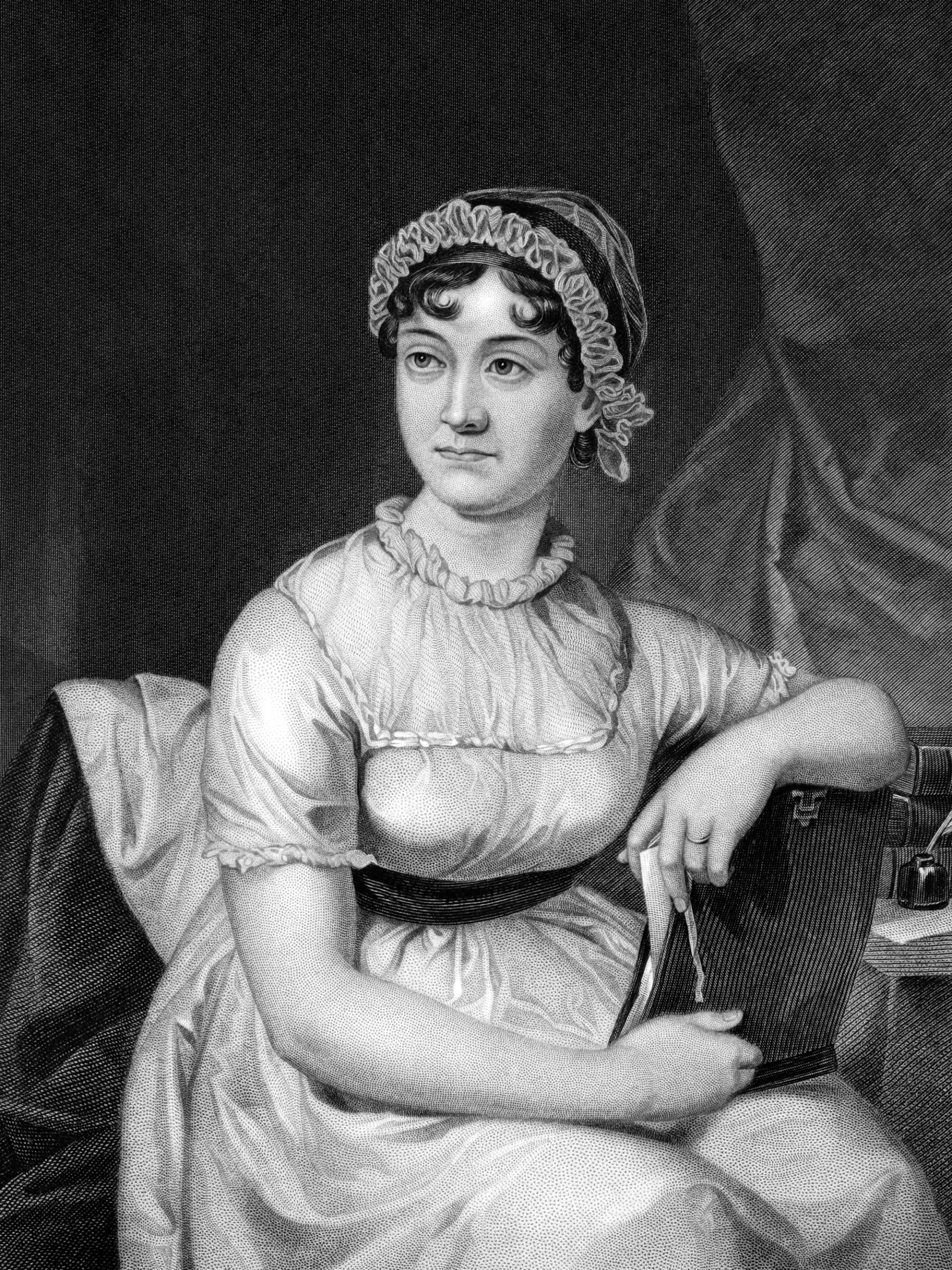
Each semester, Professor Nancy West shares interesting facts about Jane Austen with her students. Here are 10 fascinating nuggets:
She grew up in a lively literary household. Born on Dec. 16, 1775, in Steventon, Hampshire, Austen was one of eight siblings in a boisterous, book-loving family that cheered on her writing from the start.
Her “school years” were brief. Austen attended Reading Abbey Girls’ School for about a year, but most of her education came from home and devouring her father’s well-stocked library.
She started writing with style early. As a teen, Austen penned stories, plays and poems that she later gathered into her witty, wildly imaginative “Juvenilia.”
She launched her career as a mystery woman. When “Sense and Sensibility” hit shelves in 1811, the author was listed only as “By a Lady,” a common practice for women writers of her time.
She produced six classics that shaped English literature. Her major novels include “Sense and Sensibility,” “Pride and Prejudice,” “Mansfield Park,” “Emma,” “Northanger Abbey” and “Persuasion.”
She perfected the art of polite snark. Austen had a razor-sharp eye for the quirks of class, courtship and society, using humor and satire to expose the absurdities of Regency-era life.
Her own love story had plot twists. Austen did receive at least one marriage proposal (which she accepted, then quickly reconsidered), but she ultimately remained single.
We’re not sure how she died. Austen died on July 18, 1817, at the age of 41 in Winchester, Hampshire.
Her name finally appeared in print after she was gone. “Northanger Abbey” and “Persuasion” were published posthumously in 1817 and were the first of her works to credit her by name.
She never experienced financial independence. Austen wrote timeless classics, yet she never earned enough from her novels to support herself independently. Like many unmarried women in the 1800s, she relied on male relatives for housing and financial support throughout her life.